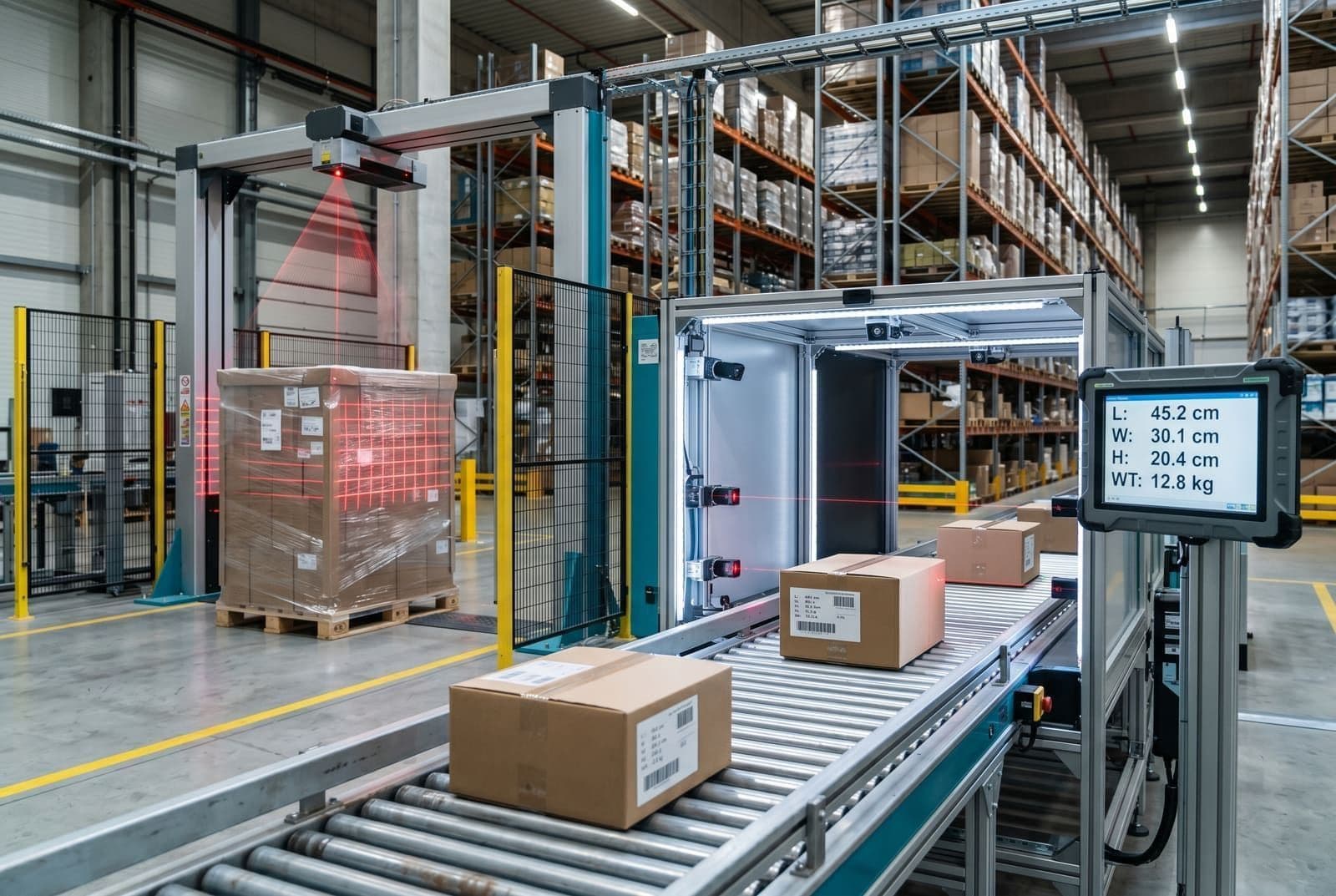
Dimensioning System Accuracy: How Much Precision Does Your Warehouse Need?

When evaluating dimensioning systems, accuracy specs can be confusing. One vendor claims ±0.2 inches. Another advertises ±0.5 inches. A third promises "carrier-grade precision" without defining what that means.
The truth is that more accuracy isn't always better—it's often more expensive. Understanding what precision level your operation actually needs prevents both overspending on unnecessary tolerance and underspending on a system that creates billing disputes.
Here's how to determine the right accuracy requirements for your warehouse dimensioning system.
Quick answer
Most parcel warehouses should target dimensioning accuracy around +/-0.25 inches when dimensions affect carrier billing or manifest data. Lower-volume internal workflows can often tolerate +/-0.5 inches, while high-volume parcel, 3PL billing, and dispute-heavy operations need tighter accuracy, strong repeatability, image proof, and sometimes NTEP certification. The right requirement depends on shipment volume, billing exposure, carrier tolerance, and the cost of disputes.
What Dimensioning Accuracy Actually Means
When a vendor specifies ±0.25 inches, they're claiming that measured dimensions will fall within a quarter-inch of true dimensions under normal operating conditions. A 24-inch box might measure anywhere from 23.75 to 24.25 inches.
But accuracy specifications hide important details:
Repeatability vs. absolute accuracy: A system might measure the same box consistently at 24.3 inches (high repeatability) while the true dimension is 24.0 inches (poor absolute accuracy). For billing purposes, you need both.
Environmental factors: Temperature changes, vibration, lighting, and conveyor speed all affect accuracy. A system accurate to ±0.2 inches in a lab might deliver ±0.5 inches on a busy dock.
Package type: Accuracy varies by package characteristics. Irregular shapes, reflective surfaces, dark materials, and non-rectangular items challenge different technologies in different ways.
When comparing systems, ask vendors about accuracy under your specific operating conditions—not just the spec sheet number.
What Accuracy Do Carriers Actually Require?
Major carriers have auditing systems that compare your declared dimensions against their measurements. Understanding their tolerance thresholds helps you choose the right system.
FedEx and UPS tolerance: Both carriers generally apply a ±0.5-inch tolerance per dimension before triggering reclassification. If your declared dimensions fall within half an inch of their scan, no adjustment occurs.
USPS tolerance: The postal service uses similar thresholds but enforces dimensional weight differently based on zone and service level.
LTL carriers: Freight carriers measuring pallets and larger items typically allow ±1-inch tolerance per dimension, though this varies by carrier and contract.
The practical implication: A dimensioning system accurate to ±0.25 inches provides buffer room within carrier tolerances. If your system measures at ±0.5 inches (worst case), you're operating right at the edge of carrier tolerance—any environmental drift creates billing disputes.
For most parcel operations, ±0.2 to ±0.25 inch accuracy provides the safety margin that prevents carrier adjustments while avoiding the cost of ultra-high-precision systems.
NTEP Certification: When Legal-for-Trade Matters
The National Type Evaluation Program (NTEP) certifies dimensioning systems for "legal-for-trade" measurements—dimensions accurate enough to use for commercial transactions where measurement determines price.
NTEP certification matters when:
- Billing customers based on cubic volume (3PLs charging by space)
- Invoicing freight by dimensional weight (carriers, freight forwarders)
- Regulated industries requiring traceable measurement standards
NTEP-certified systems undergo rigorous testing and must maintain accuracy within specified tolerances under various conditions. The certification adds cost but provides legal protection and measurement traceability.
When you don't need NTEP: If you're measuring for internal routing, WMS data, or carrier manifesting where disputes get resolved through carrier remeasurement anyway, NTEP certification may be unnecessary overhead. Many e-commerce fulfillment operations use non-certified systems successfully for years.
Accuracy Requirements by Operation Type
Different warehouse operations have different accuracy needs:
High-volume parcel shipping (500+ packages/day) Accuracy need: ±0.2 to ±0.25 inches Why: Volume amplifies errors. A ±0.5-inch system creating 2% billing disputes on 500 daily packages means 10 adjustments per day. At $8-15 per adjustment, that's $80-150 daily in avoidable fees.
3PL storage and billing Accuracy need: ±0.25 inches, consider NTEP Why: 3PL providers bill clients based on space utilization. Measurement disputes erode client trust. Legal-for-trade certification protects against challenges.
Receiving and inventory management Accuracy need: ±0.5 inches often sufficient Why: Internal slotting and putaway decisions tolerate wider variance. If a box measures 12.3 vs 12.7 inches, it still fits the same slot location.
Freight and pallet operations Accuracy need: ±0.5 to ±1.0 inches Why: Pallet dimensioning at larger scales means absolute error matters less proportionally. A half-inch variance on a 48-inch pallet is 1%—negligible for most billing purposes.
The Real Cost of Insufficient Accuracy
Choosing a dimensioning system with inadequate accuracy creates ongoing operational costs:
Carrier billing adjustments: Each dimensional weight reclassification costs $8-25 in fees plus the rate difference. At 1% dispute rate on 1,000 daily packages, that's 10 adjustments per day—potentially $200+ daily.
Labor for dispute resolution: Challenging carrier adjustments requires pulling records, generating documentation, and filing claims. Even winning disputes costs staff time.
Rate negotiation weakness: Carriers use your dimensional accuracy as leverage. Frequent disputes signal measurement problems, weakening your position in contract negotiations.
Customer chargebacks: For fulfillment centers shipping on behalf of clients, billing errors flow back as chargebacks and eroded margins.
A dimensioning system costing $5,000 more upfront but delivering ±0.2-inch vs ±0.5-inch accuracy often pays for itself within months through reduced disputes.
Technology and Accuracy Tradeoffs
Different dimensioning technologies offer different accuracy/cost tradeoffs:
Laser-based systems: Typically achieve ±0.1 to ±0.2 inch accuracy. Most consistent across package types. Higher cost, often NTEP-certifiable.
Camera-based photogrammetry: Usually ±0.25 to ±0.5 inch accuracy. Cost-effective but may struggle with reflective or dark surfaces.
AI-powered computer vision: Modern systems like Wilkins Parcel Dimensioner achieve ±0.2-inch accuracy through neural networks trained on millions of package images. Handles irregular shapes and challenging surfaces better than traditional cameras while maintaining throughput.
Hybrid approaches: Some systems combine technologies—using lasers for primary measurement with cameras for validation or exception handling.
The accuracy you need should drive technology selection, not the reverse. Starting with "we want laser accuracy" often means overspending. Starting with "we need ±0.25 inches for our shipping volume" lets you evaluate all technologies that meet the requirement.
Questions to Ask Vendors
When evaluating dimensioning systems, dig deeper than spec sheet accuracy:
-
What's the accuracy under my specific conditions? Ask about your package mix, throughput requirements, and environmental factors.
-
How is accuracy maintained over time? Systems drift. What calibration requirements exist? How often? What's the cost?
-
What's the accuracy on irregular packages? Poly bags, cylinders, and non-rectangular items challenge most systems differently.
-
Can you provide customer references at my volume? Real-world accuracy beats lab specs.
-
What happens when accuracy degrades? Does the system alert operators? Reject packages? Continue with bad data?
Making the Right Choice
For most warehouse operations, the accuracy decision comes down to shipping volume and tolerance for billing disputes:
- Under 200 packages/day: ±0.5 inch accuracy often acceptable; disputes manageable manually
- 200-1,000 packages/day: ±0.25 inch accuracy recommended; dispute volume becomes operational burden otherwise
- 1,000+ packages/day: ±0.2 inch or better; even small error rates create significant costs at scale
If you're billing customers based on dimensions (storage fees, freight charges), NTEP certification adds legal protection worth the premium.
The dimensioning accuracy you choose directly impacts daily operations and carrier relationships. Investing in the right precision level—not too much, not too little—ensures your system delivers ROI rather than ongoing friction.
Not sure what accuracy level fits your operation? The ROI calculator can help you model how different accuracy specs affect your bottom line, or explore how Sizelabs dimensioning maintains certified accuracy at speeds your operation demands.