Dimensioning System Total Cost of Ownership: What You'll Really Pay
You've seen the quotes. Maybe $8,000 for a basic static dimensioner. Perhaps $40,000 for an integrated pallet system. But anyone who's deployed warehouse automation knows the purchase price is just the opening chapter.
The real question isn't "how much does a dimensioning system cost?" It's "what will I actually spend over the next five years—and what will I get back?"
The Five Cost Categories Every Buyer Should Model
Before signing a purchase order, map out these five buckets. Vendors who can't give you clear numbers for each one probably haven't thought them through either.
1. Hardware Acquisition
This is the visible number, but it varies wildly based on your use case:
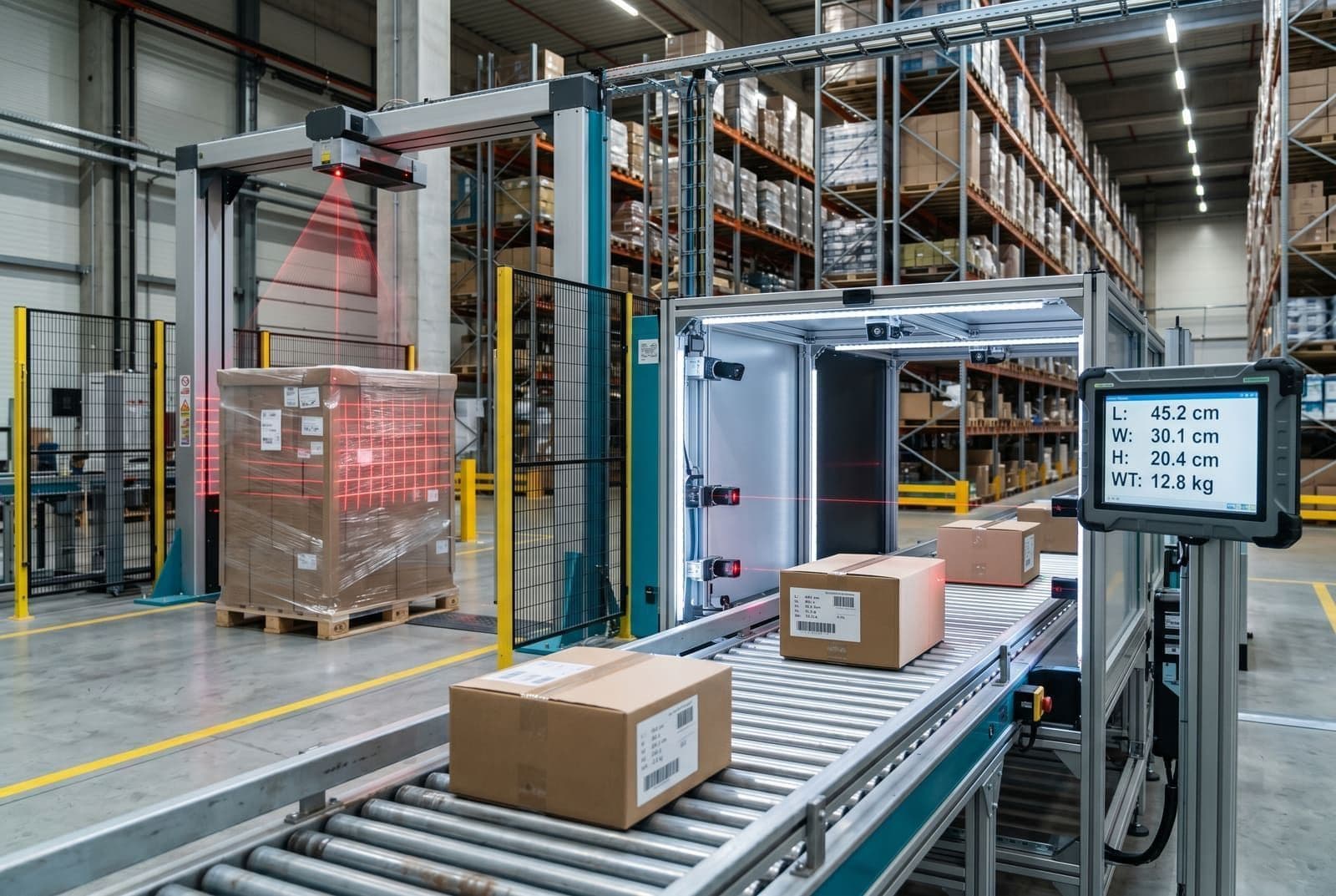
Parcel dimensioners (for packages under 100 lbs) → $4,000–$15,000 for static systems → $25,000–$80,000 for in-motion systems processing 1,200+ packages/hour
Pallet dimensioners and freight dimensioners → $15,000–$40,000 for forklift-mounted systems → $30,000–$100,000+ for floor-scale integrated systems with certified weighing
Key questions to ask:
- Does the price include mounting hardware and safety enclosures?
- What's the warranty period, and what does it actually cover?
- Are there volume discounts for multi-site rollouts?
For high-volume operations, in-motion parcel dimensioning often delivers faster payback despite higher upfront costs simply because you're not paying someone to place and remove each package.
2. Software and Licensing
Here's where costs get murky. Dimensioning hardware is useless without software to capture, process, and transmit data. Expect one of these models:
Perpetual license + annual maintenance → $2,000–$10,000 upfront → 15–20% annually for updates and support
Subscription (SaaS) → $200–$800/month per device → Often includes cloud storage, updates, and API access
Bundled with hardware → No separate fee (software included) → But watch for hidden transaction fees or data caps
The subscription model has become more common because it aligns vendor incentives with your success—they only keep getting paid if the system keeps working. But run the five-year math. A $500/month subscription costs $30,000 over five years, while a perpetual license might cost $12,000 total with maintenance.
3. Integration and Implementation
Getting dimension data into your WMS or OMS isn't automatic. Budget for:
API integration development → $5,000–$25,000 depending on WMS complexity → Custom integrations with legacy systems cost more
Network infrastructure → Ethernet drops, WiFi access points, power circuits → $500–$3,000 depending on facility readiness
Physical installation → $1,000–$5,000 for professional mounting and alignment → More for conveyor integration or overhead mounting
Project management and testing → 40–80 hours of internal staff time → Often forgotten, but very real
The vendors with the smoothest deployments have pre-built integrations with major WMS platforms. Ask for a list of existing connectors and reference customers running your same WMS.
4. Training and Change Management
A dimensioning system doesn't run itself. Your team needs to know:
- How to operate the equipment daily
- How to recognize and clear errors
- When to escalate vs. troubleshoot
- How to interpret and act on dimension data
Initial training → $1,000–$5,000 (often included with purchase) → 4–16 hours depending on complexity
Ongoing training for new hires → 2–4 hours per person → Document procedures now or pay later
Change management → The hardest cost to quantify → Expect 2–4 weeks of productivity dip during transition
The 3PL operations with the smoothest dimensioning deployments assign a "system champion"—someone who becomes the internal expert and trainer. Factor in 10–20% of one person's time during the first three months.
5. Ongoing Maintenance and Calibration
Dimensioning systems need care. Cameras get dusty. Sensors drift. Software needs updates. Here's what to plan for:
Annual calibration → $500–$2,000 per device → Required for NTEP-certified accuracy in carrier billing
Preventive maintenance → $1,000–$3,000 annually → Cleaning, alignment checks, firmware updates
Break-fix repairs → Budget 2–5% of hardware cost annually after warranty → Keep spare sensors on hand for critical components
Software updates → Included in subscription or maintenance fee → But test updates in staging before production rollout
Systems with fewer moving parts generally require less maintenance. Solid-state sensors beat mechanical components. Cloud-connected systems that self-diagnose issues save on troubleshooting time.
Building Your Five-Year TCO Model
Let's put real numbers to a mid-market scenario: a fulfillment center processing 5,000 parcels daily, deploying two static dimensioners for receiving QC.
Year 0 (Acquisition)
- Hardware (2 units): $16,000
- Software perpetual license: $6,000
- Integration: $8,000
- Installation: $2,000
- Training: $2,000
- Year 0 Total: $34,000
Years 1–5 (Annual)
- Software maintenance (18%): $1,080
- Calibration (2 devices): $2,000
- Preventive maintenance: $2,000
- Break-fix (3% of hardware): $480
- Annual Total: $5,560
Five-Year TCO: $34,000 + (5 × $5,560) = $61,800
That's $12,360 per year, or roughly $0.007 per package dimensioned (at 5,000/day × 250 working days = 1.25M packages).
Compare that to manual dimensioning: if a worker can measure 100 packages/hour at $20/hour loaded labor cost, you're paying $0.20 per measurement—almost 30x the automated cost.
Use our ROI calculator to run the numbers for your specific volume and labor costs.
The Hidden Costs Nobody Mentions
Even experienced buyers miss these:
Opportunity cost of delays Every week you spend in vendor selection is another week paying the manual-measurement premium. A 3-month buying cycle that could have been 6 weeks costs you 6 weeks of savings.
Data quality issues If your dimensioner produces inconsistent data, downstream systems—billing, slotting, cartonization—make bad decisions. Cheap hardware with poor accuracy creates expensive problems.
Vendor lock-in Proprietary data formats, closed APIs, and hardware-specific software make switching painful. Ask about data portability before you buy.
Scaling bottlenecks A system that works at 5,000 packages/day might choke at 15,000. Dynamic dimensioning costs more upfront but eliminates throughput ceilings.
Compliance penalties If you're using dimension data for carrier billing and your system isn't properly calibrated, you're exposed to audit chargebacks. One bad audit can cost more than the entire system.
Negotiation Leverage Points
Vendors have margin in these areas—use them:
Multi-year software agreements Commit to 3 years upfront for 15–25% discount on annual fees.
Bundle installation with training Vendors often discount professional services when bundled.
Reference customer pricing Agree to be a reference account or case study in exchange for 5–10% off.
Volume commitments If you have multiple sites, negotiate a master agreement with per-unit pricing.
Extended warranty Often cheaper than break-fix budgeting, especially for year 2–3.
What Good Vendors Provide Upfront
The best dimensioning vendors—the ones who actually want long-term relationships—will give you:
- Detailed TCO projections in their proposals
- Reference customers with similar use cases
- Integration documentation before purchase
- Clear SLAs for support response times
- Transparent pricing on all recurring costs
- Trial periods or proof-of-concept deployments
If a vendor dodges TCO questions, that's a signal. Either they don't know their own economics, or they don't want you to know.
The Decision Framework
Before committing:
-
Calculate your manual baseline – What are you spending today on measurement labor, billing disputes, and cartonization errors?
-
Model three scenarios – Budget, mid-tier, and premium options with full TCO
-
Talk to references – Ask about total spend, not just satisfaction
-
Plan for growth – Will this system handle your volume in 3 years?
-
Get integration clarity – Who owns the WMS connection, and what does it cost?
The right dimensioning system pays for itself. But only if you understand what "itself" actually costs. Do the math, ask hard questions, and invest in equipment that delivers accuracy at a total cost you can defend.
Evaluating dimensioning options for your warehouse? Request a consultation to discuss your specific requirements and see how Sizelabs approaches total cost transparency.