Warehouse Space Utilization: How to Get More From Your Existing Footprint
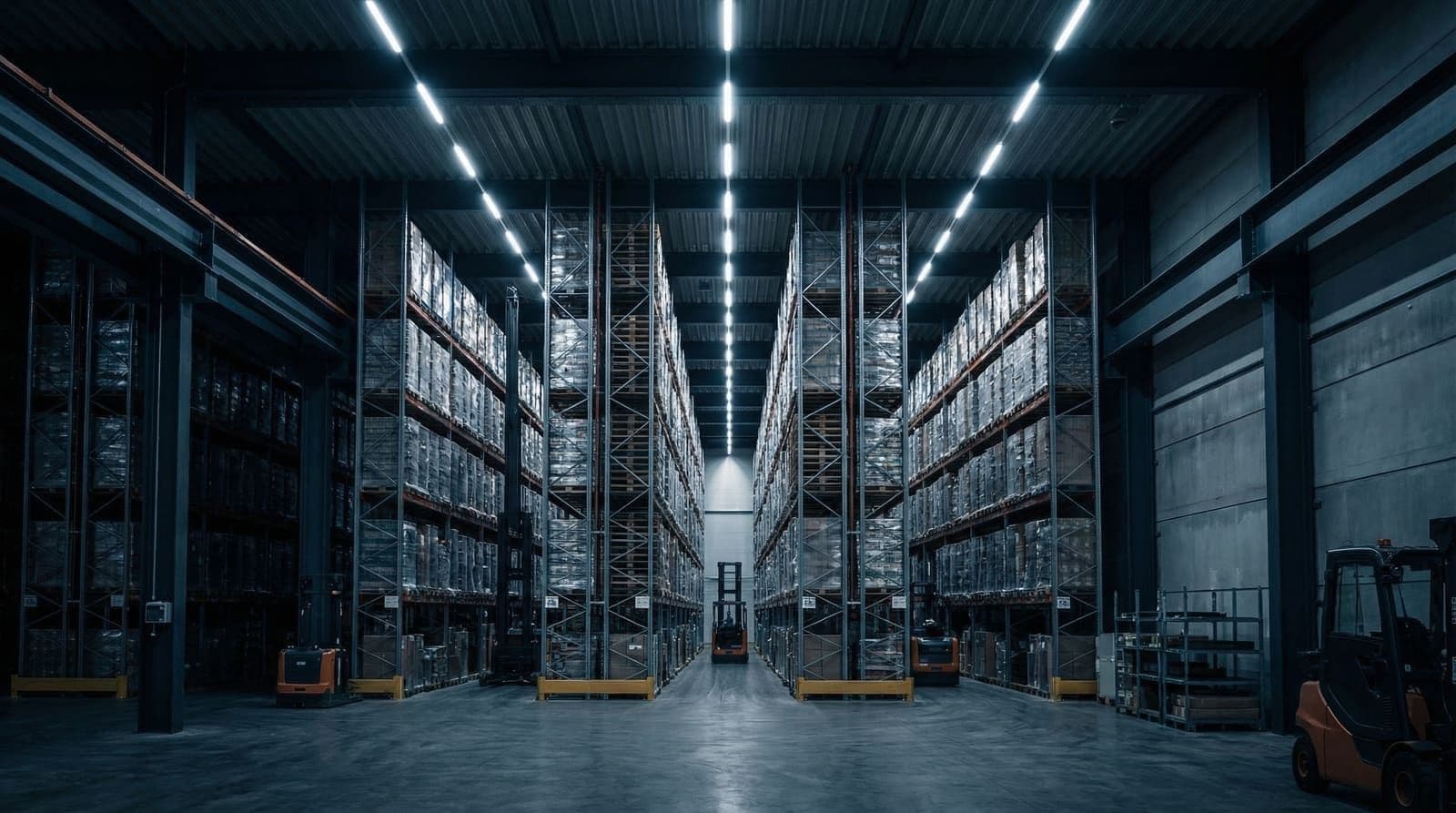
Every warehouse manager knows the feeling: inventory keeps growing, but your footprint doesn't. Before you start scouting new real estate or signing expensive lease expansions, there's a more practical question to ask—are you actually using the space you already have?
Most warehouses operate at 22-27% space utilization. That's not a typo. The average facility has roughly three-quarters of its cubic capacity sitting underutilized. The problem isn't always "not enough space"—it's often "not using space well."
What Is Warehouse Space Utilization (and Why Cubic Matters)
Space utilization measures how efficiently you're using your available warehouse capacity. But here's where most operations get it wrong: they calculate floor utilization instead of cubic utilization.
Floor utilization = occupied floor area ÷ total floor area
Cubic utilization = occupied cubic volume ÷ total cubic volume
Floor metrics miss the biggest opportunity—vertical space. A warehouse might show 80% floor utilization while leaving 60% of its vertical capacity empty. That's expensive air you're paying rent on.
The formula that actually matters:
True Space Utilization = (Occupied Cubic Volume) ÷ (Total Available Cubic Volume) × 100
Industry benchmarks suggest targeting 25-30% cubic utilization for operations that need picking accessibility, and up to 85% for bulk storage zones.
How to Measure Your Current Utilization
You can't improve what you don't measure. Here's a practical approach:
Step 1: Map Your Zones
Divide your warehouse into functional zones:
- Bulk storage (full pallet locations)
- Pick/forward locations
- Staging areas (inbound and outbound)
- Returns processing
- Value-added services areas
Step 2: Calculate Capacity Per Zone
For each zone, determine:
- Total cubic feet available (length × width × usable height)
- Current cubic feet occupied
- Peak vs. average occupancy
Step 3: Identify the Gaps
Look for zones with chronic underutilization (<20%) or constant overflow (>90%). Both signal problems—wasted space or bottlenecks.
A quick audit tip: walk your warehouse at different times of day. Is that staging area empty every morning? Is that bulk zone overflowing by Wednesday? Patterns reveal optimization opportunities.
Five Strategies That Actually Move the Needle
1. Reclaim Vertical Space
This is the lowest-hanging fruit in most operations. Practical steps:
- Audit clear heights: Measure actual clearance in each zone. Many warehouses have 10+ feet of usable height they're not touching.
- Add racking levels: If your current racks are 3-high but you have clearance for 5, you're leaving 40% on the table.
- Use vertical lift modules (VLMs): For small-parts storage, VLMs can recover 85% of floor space while improving pick speed.
One distribution center in Ohio added two rack levels to their bulk zone and deferred a planned expansion by three years—saving $2.4M in real estate costs.
2. Right-Size Your Slot Assignments
Products don't all deserve the same real estate. Yet most warehouses allocate space based on what fit "last time" rather than what makes sense now.
Effective slotting means:
- Fast movers get prime, easily accessible locations at golden zone height
- Slow movers go up high or into reserve areas
- Variable demand items get flexible allocation that adjusts seasonally
Review your velocity data quarterly. A product that was an A-mover six months ago might be a C-mover today—but it's still hogging prime picking space.
3. Tighten Your Aisle Strategy
Standard aisles run 10-12 feet wide for counterbalance forklifts. But ask yourself:
- Do you actually need that width everywhere?
- Could narrow-aisle or very narrow-aisle (VNA) equipment work in some zones?
Switching to VNA in appropriate zones can recover 40-50% of aisle space. Yes, it requires different equipment, but the ROI often hits within 18 months.
4. Attack Staging Area Bloat
Staging areas have a way of growing when no one's watching. Inbound staging expands because receiving can't put away fast enough. Outbound staging grows because shipping is waiting on orders.
The fix isn't more staging space—it's faster throughput:
- Set dwell-time limits (e.g., nothing sits in staging more than 4 hours)
- Track staging occupancy as a KPI
- Address root causes: slow putaway, late picks, shipping bottlenecks
If your staging areas consistently exceed capacity, that's a process problem masquerading as a space problem.
5. Know Exactly What You're Storing
Here's where many operations fly blind: they don't actually know the dimensions of their inventory. They estimate. They round up. They use "standard" case sizes that haven't been standard for years.
Accurate dimensions matter for space planning. If you're allocating 24×24×24 inches for a product that actually measures 20×18×22, you're wasting 40% of that slot capacity—multiplied across thousands of SKUs.
Modern dimensioning systems capture actual product measurements automatically during receiving. That data feeds directly into slotting optimization and capacity planning. No more guesswork.
Common Space Utilization Mistakes
Mistake #1: Treating all space equally
Not all cubic feet have the same value. Space near dock doors is worth more than space in the back corner. Prime picking zones are worth more than bulk reserve areas. Optimize accordingly.
Mistake #2: Ignoring seasonality
If your utilization swings from 50% in February to 95% in November, you need a flexible space strategy—not a fixed layout designed for one scenario.
Mistake #3: Over-indexing on density
There's a point where higher density creates more problems than it solves. If achieving 90% utilization means pick times double and damage rates spike, you've optimized the wrong metric.
Mistake #4: Underestimating data quality
Space planning is only as good as the data feeding it. If your WMS shows 500 pallets in reserve but a physical count shows 380, your utilization calculations are fiction. Regular inventory audits and accurate dimensional data capture keep planning grounded in reality.
Measuring Improvement: The KPIs That Matter
Track these monthly:
→ Cubic utilization by zone (target varies: 25-30% pick areas, 80%+ bulk)
→ Space cost per unit stored (total facility cost ÷ units in storage)
→ Dwell time in staging (target: <4 hours inbound, <2 hours outbound)
→ Vertical space utilization (occupied height ÷ available height)
→ Slot efficiency (actual product volume ÷ allocated slot volume)
Set baselines, then drive improvement. A 5% utilization gain in a 200,000 sq ft warehouse is equivalent to 10,000 sq ft of free space—at $8/sq ft annually, that's $80,000 back in your budget.
The Bottom Line
Warehouse space is expensive. Expanding is more expensive. Before you sign that lease extension, squeeze more value from what you have.
Start with measurement—actual cubic utilization, not floor-based estimates. Identify your biggest gaps. Then attack them systematically: vertical space, slotting, aisles, staging, and data quality.
The operations that get dimensioning right gain a compounding advantage. Accurate product dimensions enable better slotting, tighter storage, and smarter capacity planning. It's not glamorous work, but it's the work that keeps facilities running efficiently as volume scales.
Your warehouse probably isn't out of space. It's out of optimization.