Warehouse Cartonization: How to Pick the Right Box Every Time
Every time a packer grabs an oversized box, you're paying to ship air. Every time they squeeze items into a too-small carton, you're risking damage claims. The gap between "any box that fits" and "the right box" represents one of the biggest hidden costs in warehouse operations.
Cartonization—the process of determining the optimal box size for each order—sounds simple. In practice, most warehouses get it wrong, often without realizing how much it's costing them.
The Math Behind Bad Box Selection
Consider a typical scenario: a packer needs to ship three small items. They grab a medium box because it's within reach, add void fill, tape it up, and move on. That decision just cost you money in three ways:
Dimensional weight charges: Carriers bill by whichever is greater—actual weight or dimensional weight. An oversized box pushes your shipment into a higher billing tier even if the contents weigh almost nothing.
Void fill costs: That crumpled paper or air pillows keeping items from rattling around? At $0.15-0.30 per shipment, it adds up to thousands annually for a mid-sized operation.
Carton inventory: Stocking too many box sizes ties up capital and floor space. Stocking too few forces packers to use whatever's available rather than what's optimal.
The shipping industry estimates that 20-40% of package volume is empty space. For e-commerce fulfillment operations, that translates to 15-25% in avoidable shipping costs.
Why Packers Default to Oversized Boxes
Before fixing cartonization, understand why it breaks in the first place. In most warehouses, the root cause isn't carelessness—it's system design:
Speed pressure: Packers measured on units-per-hour will always grab the nearest box rather than walk to get the right size. The math makes sense for them even when it doesn't for you.
Missing information: Without knowing the combined dimensions of items in an order, packers can't make informed decisions. They estimate, usually overshooting to avoid repacks.
Box availability: If the right size isn't within arm's reach, it won't get used. Physical layout trumps policy every time.
No feedback loop: Packers rarely see carrier invoices. The person making box decisions never learns the cost of those decisions.
Building a Cartonization Strategy
Effective cartonization balances three competing goals: minimizing shipping cost, maintaining pack station throughput, and managing carton inventory. Here's how to approach each:
1. Rationalize Your Box Assortment
Most warehouses carry too many box sizes (creating confusion and inventory bloat) or too few (forcing bad fits). The sweet spot for typical e-commerce operations is 8-12 standard sizes.
Start by analyzing your order profiles. Pull three months of shipping data and calculate the combined dimensions of items in each order. Look for natural clustering—you'll typically find that 80% of orders can be handled by 4-5 box sizes.
Key dimensions to optimize:
- Length + width for base coverage — items should fit the footprint with minimal wasted space
- Height for stacking — variable-depth or right-height boxes help here
- Cube efficiency — target 70-85% fill rate after void fill
Avoid the trap of adding "just one more size" every time you encounter an edge case. Each additional SKU in your carton inventory creates picking complexity, storage requirements, and reorder overhead.
2. Capture Product Dimensions at the Source
You can't calculate optimal box selection without knowing what's going into the box. This requires accurate dimensional data for every SKU in your catalog—not estimates, not "close enough," but actual measurements.
For warehouses handling diverse product mixes, parcel dimensioning systems automate this capture during receiving or slotting. The investment pays back quickly: one study found that warehouses with accurate dimension data reduced carton usage by 18% within six months.
Build the habit of capturing dimensions when products first enter your operation:
- At receiving: Measure new SKUs before they hit inventory
- During slotting: Verify dimensions match what's in the system
- On exception: Flag and re-measure items that cause frequent pack-station problems
3. Implement System-Driven Recommendations
Once you have accurate product dimensions, your WMS or order management system can calculate recommended box sizes automatically. The calculation itself is straightforward—you're essentially bin-packing items into the smallest container that fits.
The challenge is surfacing that recommendation to packers in a way that doesn't slow them down:
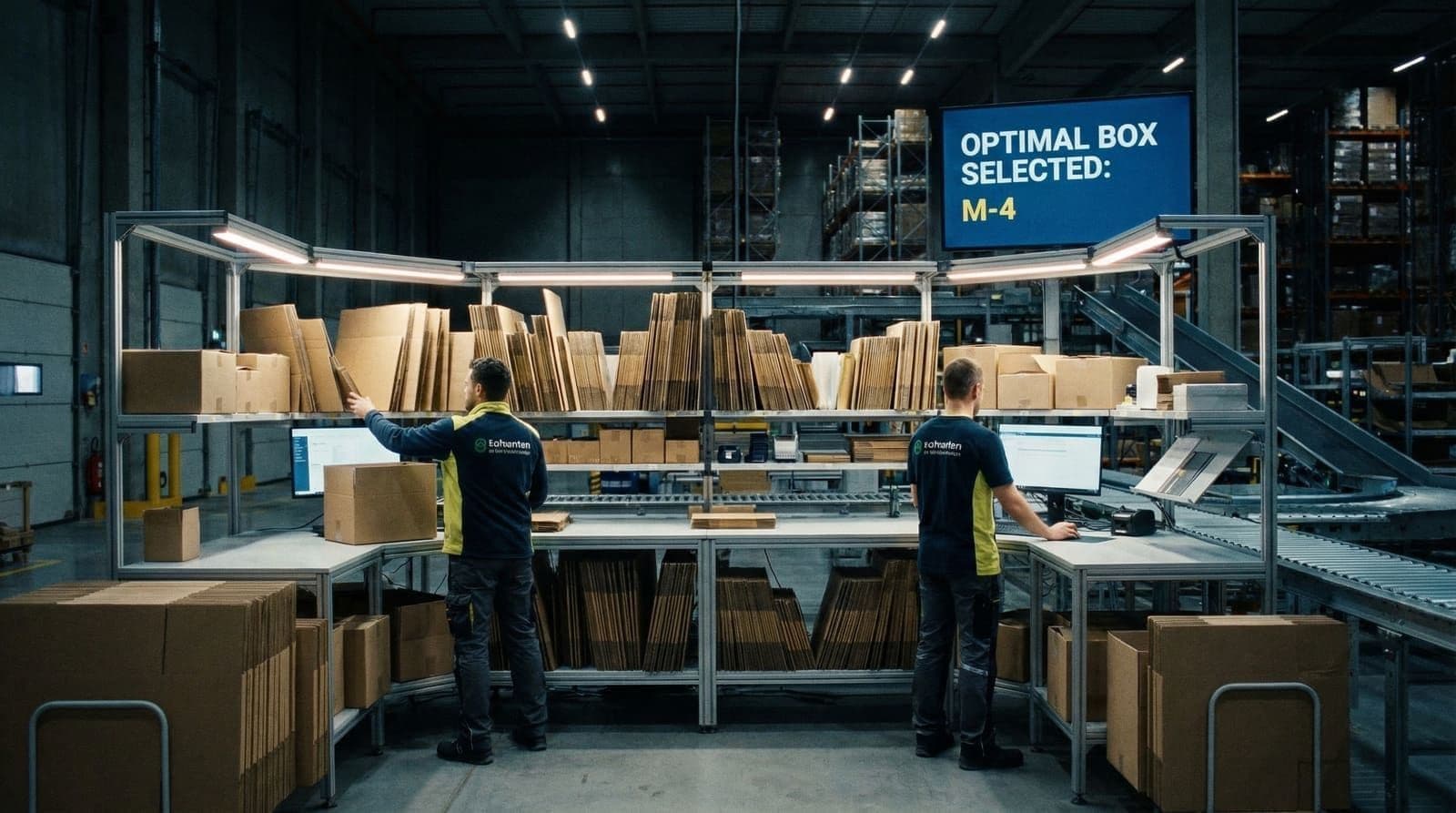
Pack station displays: Show the recommended box size and location on the screen before the packer starts the order
Zone picking by box size: Route orders to stations pre-staged with the likely carton size
Pick-to-box: For batch picking operations, assign the carton at pick start rather than pack
Voice-directed packing: Announce box recommendations through voice pick systems
The key is reducing decision overhead. If a packer has to stop, think, and choose, throughput drops. If the system makes the decision and they just confirm, speed stays high.
4. Design Your Pack Stations for Compliance
Even the best recommendation system fails if the right box requires walking across the warehouse. Physical layout determines behavior more than training or policy.
Within arm's reach: Place your highest-velocity box sizes in the primary position at each station. Analyze pack data to determine which sizes get used most at each station.
Gravity flow: Use tilted shelving or flow racks that present boxes at grab height and replenish from behind. Packers shouldn't bend, reach, or hunt.
Right-handed and left-handed setups: A trivial-seeming detail that impacts ergonomics and speed. Mirror station layouts based on packer preference.
Visual systems: Color-code or number box sizes. A "grab the blue box" system beats "grab the 12x10x6" every time. Train eyes, not memory.
5. Close the Feedback Loop
The people making box decisions need to see the impact of those decisions. Without feedback, cartonization degrades over time as small shortcuts become standard practice.
Weekly variance reports: Show shipping cost variance against optimal cartonization. Break it down by packer, station, and shift.
Exception tracking: Monitor orders that get repacked due to wrong box selection. Repacks are your canary—if they're rising, something broke upstream.
Carrier audit results: Share DIM weight adjustments and reclassifications with the pack team. Let them see the carrier's perspective.
Gamification (optional): Some operations run friendly competition around cartonization accuracy. Use cautiously—you don't want packers optimizing for score at the expense of throughput.
Common Cartonization Mistakes
Over-engineering the algorithm: Perfect box selection that takes 30 seconds per order costs more than slightly imperfect selection that takes 2 seconds. Aim for "good enough" at speed.
Ignoring fragility: The smallest box that fits isn't always the best choice. Fragile items need void fill space. Build product fragility attributes into your cartonization logic.
Forgetting multi-box orders: Some orders should ship in multiple smaller boxes rather than one large one. Your system should evaluate this trade-off automatically.
Static station design: Order profiles change seasonally. What works in Q1 might fail during peak season when your product mix shifts. Review and adjust station layouts quarterly.
Measuring Cartonization Performance
Track these metrics to understand your cartonization health:
Fill rate percentage: Average percentage of carton cube occupied by product. Target 70-85%—lower means wasted space, higher risks damage.
DIM weight ratio: Ratio of billed dimensional weight to actual weight. Rising ratio indicates growing box inefficiency.
Repack rate: Percentage of orders requiring box changes at QC. Should be under 2%.
Void fill cost per shipment: Direct material cost indicator. Track trend over time rather than absolute number.
Box SKU turns: How quickly you cycle through carton inventory. Low turns on specific sizes suggest you're stocking boxes you don't need.
Getting Started
If you're running a manual cartonization process today, start with the data. Pull your shipping history and analyze the gap between actual box sizes used and theoretical optimal sizes. That gap represents your opportunity.
For most operations, the path forward is:
- Audit your current box assortment and order profiles
- Capture accurate dimensions for your top-volume SKUs using parcel dimensioning or manual measurement
- Configure your WMS or OMS to recommend box sizes
- Redesign pack stations to make the right choice the easy choice
- Implement reporting to track improvement and catch regressions
Cartonization isn't glamorous. It won't make your LinkedIn posts. But it's one of the highest-ROI improvements a warehouse can make—reducing costs without requiring more labor, more space, or faster equipment. Just smarter box selection.
For operations looking to automate dimension capture across receiving and pack stations, Sizelabs' solutions integrate directly with WMS platforms to enable real-time cartonization optimization.