Warehouse Returns Process: KPIs and Workflow to Cut Cycle Time
A slow warehouse returns process creates hidden congestion that most teams only notice once labor costs spike or inventory accuracy drops. Returns do not just consume labor in a corner of the building—they compete for dock space, scanning capacity, QA time, and putaway bandwidth. If your operation is handling more eCommerce and omnichannel volume, returns are now a core workflow, not an exception flow.
Treat returns as a measurable workflow before changing staffing or systems. Start with a consistent receipt-to-disposition baseline, clear triage rules, and named owners for each handoff. Set improvement targets only after the operation can compare like-for-like returns by category and reason.
Why the Warehouse Returns Process Breaks Down
Most bottlenecks come from one of three issues:
- No triage standard: Two operators evaluate the same item and choose different paths.
- Weak reason coding: Return reasons are too generic ("damaged" or "customer return"), so root causes stay hidden.
- Disconnected systems: Physical inspection happens on the floor, but WMS updates lag by hours.
When this happens, returns pile up in staging. Planners cannot trust available inventory. Customer service sees conflicting statuses. And frontline teams burn time re-handling the same units.
If this sounds familiar, start by isolating returns flow from inbound freight receiving. High-performing fulfillment centers typically run returns with separate lanes, labor plans, and SLA ownership.
Warehouse Returns Process KPIs to Track Weekly
If you only track total return count, you are flying blind. A useful KPI set should show speed, quality, and financial recovery.
1) Return cycle time (receipt to final disposition)
Measure median and P90 hours. P90 reveals bottlenecks that averages hide.
2) First-touch resolution rate
Percentage of returns resolved in one handling event. Low rates indicate unclear decision rules or missing data at intake.
3) Recovery rate
Share of returned units restocked to sellable inventory. Segment by SKU family and return reason.
4) Cost per return processed
Include labor minutes, packaging materials, internal transport, and reconditioning steps.
5) Repeat return rate
How often the same SKU returns again within a follow-up window defined for the operation. This points to quality issues, listing errors, or wrong-pack problems.
Build a target model from your own baseline:
- Cycle time: define receipt and final-disposition timestamps, then review the median and P90 by priority and item family.
- First-touch resolution: count returns resolved without a second inspection, data correction, or unplanned move.
- Recovery rate: segment outcomes by disposition and compare recovered value with the handling cost.
Agree on local targets with operations, inventory, and finance after reviewing a complete baseline. A useful SLA depends on product risk, value, velocity, seasonality, approvals, and available capacity; one threshold will not fit every return.
Teams managing high parcel volume often connect these metrics to outbound controls, including package verification and dimensioning workflows, to reduce avoidable returns triggered by wrong-item or wrong-pack events.
How to Standardize Your Warehouse Returns Process in 7 Steps
1) Create a reason-code taxonomy that operations can actually use
Limit your code list to actionable categories. Example structure:
- Carrier damage
- Pick/pack error
- Customer preference (no defect)
- Product defect
- Late delivery or refused shipment
Avoid long free-text fields as primary inputs. Free text is useful for notes, but decision logic should run on structured codes.
2) Define triage SLAs by value and velocity
Do not apply one SLA to every return. Set the first-decision window using local inventory value, velocity, seasonality, product risk, and staffing. Define when the clock starts and stops, who owns missing RMA or evidence, and which approvals pause the item from moving.
Review the baseline and exception aging before changing the window. That shows where decision time accumulates and whether a tighter target is compatible with safe inspection and accurate inventory updates.
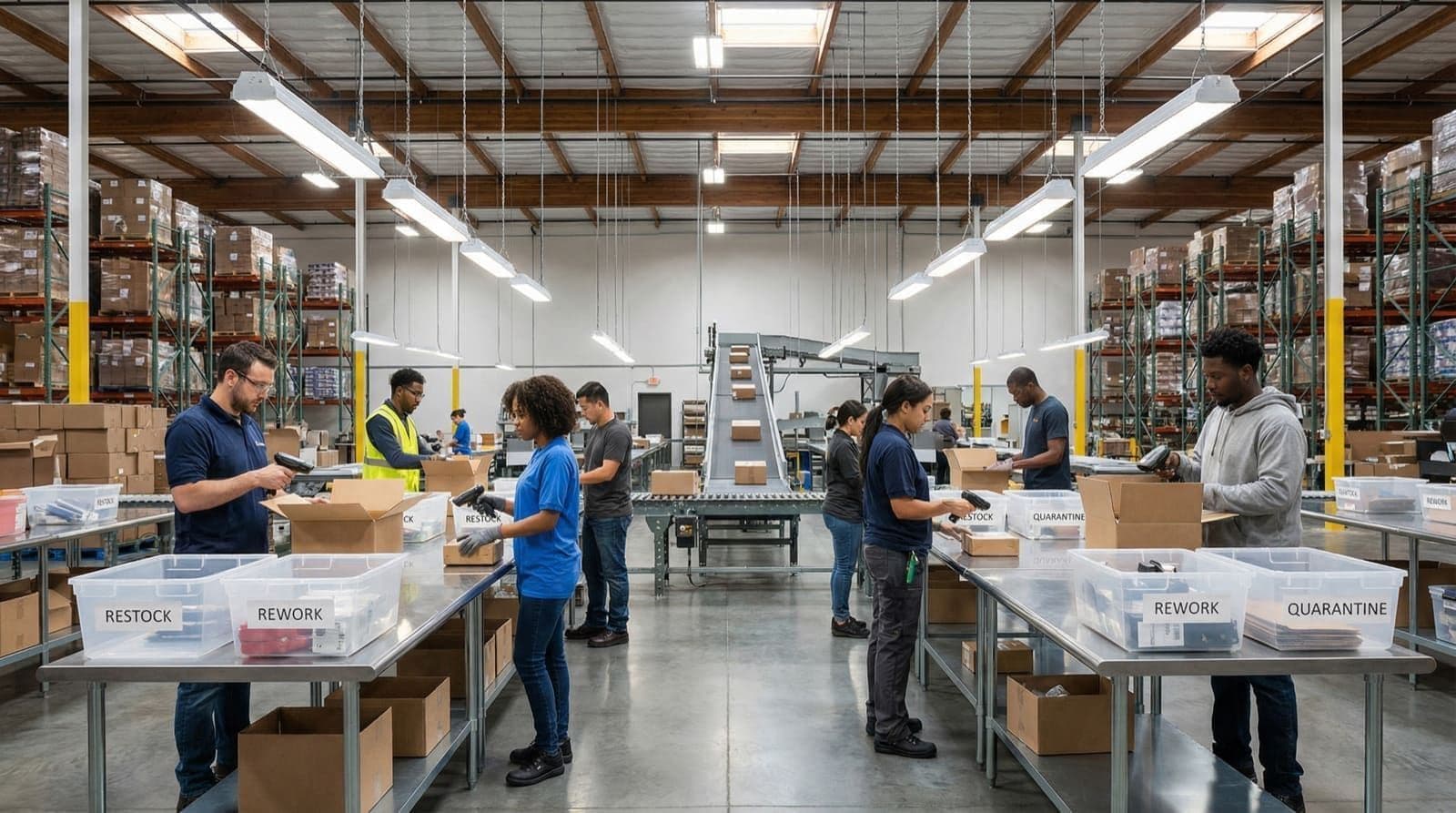
3) Build a dedicated triage cell with visual standards
Treat returns like a mini production line:
- intake scan
- condition check
- disposition decision
- route to restock/rework/quarantine
Use visual criteria boards for "sellable," "rework," and "quarantine" to reduce decision variability across shifts.
4) Align disposition rules with finance and compliance
Operations should not invent value thresholds ad hoc. Pre-define when to:
- restock directly
- rebox/relabel
- send to refurbishment
- submit carrier claim
- scrap
This is especially important for 3PL environments where client contracts define recovery obligations and timelines. If you support multiple brands, a 3PL operating model with client-specific rules can prevent expensive exceptions.
5) Connect WMS status updates to every physical handoff
Every transfer point should trigger a status update. If inventory changes location but system status lags, planners and customer teams make bad decisions.
At minimum, map these statuses:
- received-return
- pending-inspection
- approved-restock
- rework-in-progress
- quarantine-hold
- disposition-complete
6) Build an exception lane for claims and compliance cases
Carrier-damage and vendor-compliance cases should move to an exception queue with timestamped evidence (photos, scans, dimensions, packing context). This reduces write-offs and speeds claim adjudication, especially when teams already operate under strict carrier dimensional policy controls.
7) Run monthly root-cause reviews to prevent future returns
The strongest returns teams are not just good at processing—they are good at prevention. Monthly reviews should identify whether returns originate from:
- listing/content mismatch
- pick accuracy issues
- packaging failures in transit
- product quality defects
- delivery promise mismatch
Push findings upstream to merchandising, packaging engineering, and outbound operations.
Staffing and Layout Decisions That Move the Needle
You do not need a new building to improve returns flow. Small layout and labor changes produce outsized gains:
- Cross-train a flexible returns pod that can scale during peak windows.
- Place triage near reslotting/putaway paths to reduce internal travel.
- Separate clean vs. contaminated streams for faster quality decisions.
- Use hourly WIP caps so work does not accumulate unseen.
A simple rule works well: if returns WIP exceeds one shift of capacity, trigger overflow labor and narrow intake priorities to high-value lanes first.
Common Mistakes to Avoid
- Treating returns as “when we have time” work
- Measuring team speed without measuring recovery quality
- Letting exception cases mix with standard returns flow
- Ignoring P90 cycle time and focusing only on averages
- Delaying systems integration until after process changes
A stable process beats a clever process. Consistency across shifts is what produces predictable cycle times.
Final Takeaway
A high-performing warehouse returns process is a competitive advantage: faster inventory recovery, lower avoidable labor, and cleaner root-cause data for continuous improvement. Start with triage standards and KPI cadence, then tighten integrations and exception handling.
If you are currently mapping your returns-to-recovery workflow, Sizelabs can help you connect operational checkpoints with real-time data capture so your team resolves returns faster without losing control of quality or cost.