How to Improve Warehouse Shipping Accuracy (and Stop Losing Money on Mispicks)

A mispick costs you twice. Once when you ship the wrong item, and again when you process the return, reship the correct product, and deal with the customer service fallout. For most warehouses, the fully-loaded cost of a shipping error lands somewhere between $15 and $50 per incident — and that's before you factor in the customer relationship damage.
Yet despite knowing this, many operations hover around 97-98% shipping accuracy and treat it as "good enough." It's not. At 98% accuracy with 1,000 orders per day, you're shipping 20 wrong packages daily. That's 600 errors per month, potentially $20,000 or more walking out the door.
Here's how to actually fix it.
Why Shipping Errors Happen (Hint: It's Rarely the Picker)
When accuracy drops, the instinct is to blame the picker. But in most warehouses, the root causes are systemic. The picker is just the last person to touch the order before it goes wrong.
Location accuracy problems account for roughly 40% of mispicks. If the inventory isn't where the WMS says it is, even a perfect picker will grab the wrong item. This traces back to receiving errors, putaway mistakes, and cycle count gaps.
Look-alike SKUs cause another 25-30% of errors. Two products with similar packaging sitting next to each other is a mispick waiting to happen. Experienced pickers learn which SKUs are dangerous, but new hires don't have that tribal knowledge.
Pick ticket ambiguity handles most of the rest. Unclear location formats, missing product images, or SKU descriptions that don't match what's on the shelf force pickers to make judgment calls. Judgment calls under time pressure lead to mistakes.
Build a Ship Station That Actually Catches Errors
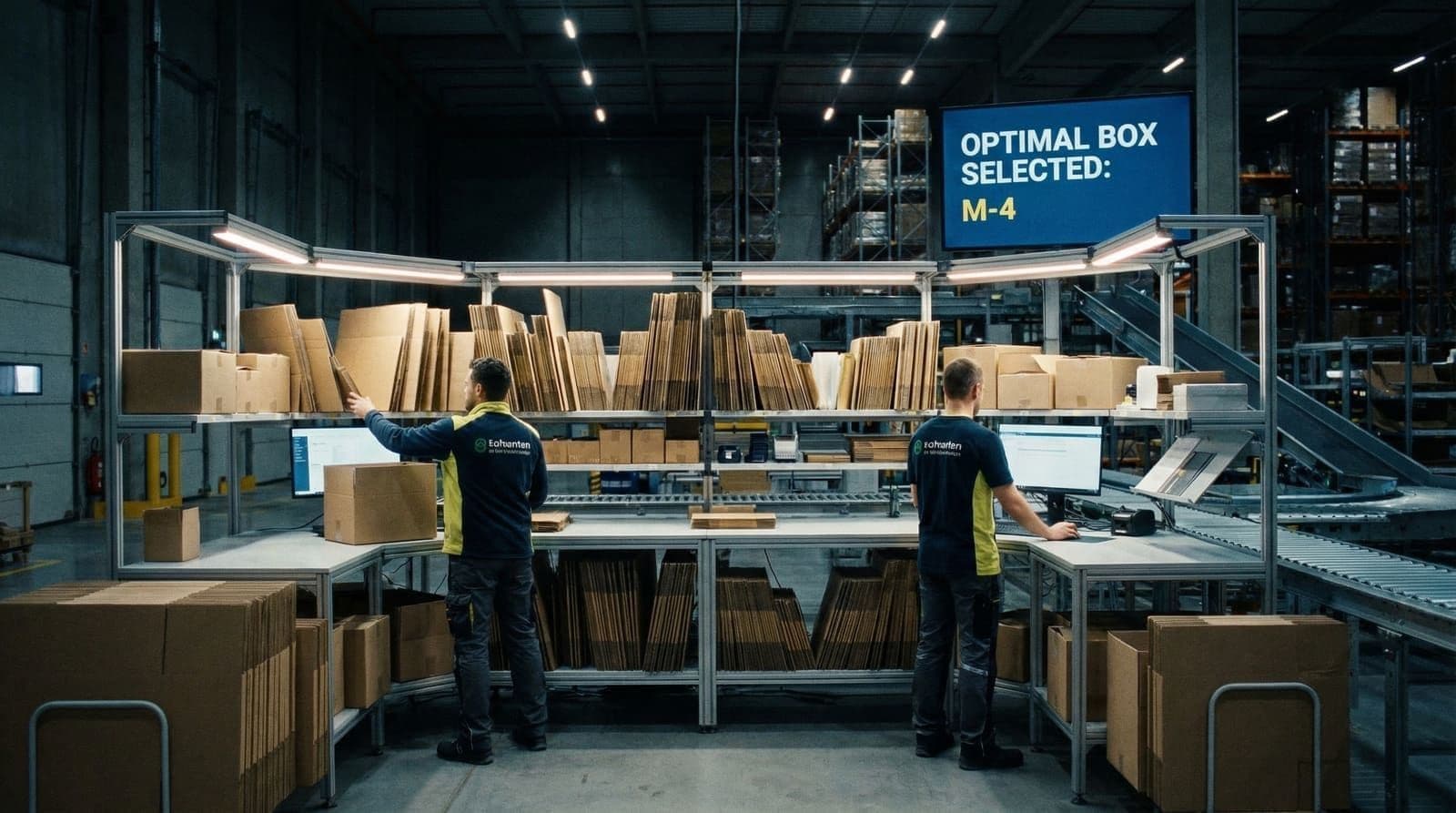
The pick is where most errors originate, but the pack station is where you catch them. A well-designed fulfillment center treats pack-out as a verification step, not just a boxing exercise.
Scan-to-verify at pack is non-negotiable for high-accuracy operations. Every item gets scanned before it goes in the box. The system confirms the SKU matches the order, the quantity is correct, and any serial numbers or lot codes are captured. This single step typically improves accuracy by 1-2 percentage points.
Weight verification adds another layer. If your average order weighs 2.3 lbs and the scale reads 4.1 lbs, something's wrong. Some WMS platforms flag weight discrepancies automatically; if yours doesn't, even a simple visual check of scale readings catches obvious doubles and wrong-item errors.
Dimensional verification matters too, especially for operations dealing with carrier billing audits. When the package dimensions captured at ship don't match the expected profile, it could indicate a wrong item, missing item, or incorrect packaging. Systems with integrated dimensioning flag these anomalies before the package leaves.
Zone Picking vs. Discrete Picking: Pick the Right Method
Your pick methodology shapes your error profile. There's no universally "best" approach — it depends on your order characteristics.
Discrete picking (one picker, one order, start to finish) has the lowest inherent error rate because there's no handoff. But it's also the least efficient for multi-item orders in large facilities. If a picker has to traverse the entire warehouse for every order, productivity tanks.
Zone picking (pickers stay in assigned areas, orders accumulate across zones) improves productivity but introduces handoff errors. Each zone transition is a potential failure point. The fix is clear zone boundaries, standardized tote labeling, and a consolidation station that verifies completeness before pack-out.
Batch picking (multiple orders picked simultaneously) is efficient but dangerous. Sorting items into the correct orders at the end of a batch wave is where mistakes happen. If you batch pick, invest in pick-to-light or put-to-light systems that make the sort step nearly foolproof.
The Receiving-Shipping Connection Most Warehouses Miss
Here's something counterintuitive: improving receiving accuracy is often the fastest way to improve shipping accuracy. Problems at the dock cascade downstream for weeks.
If a receiving clerk miscounts a case quantity or scans the wrong SKU, that bad data infects your inventory. The next picker who goes to that location might find a different product than expected. They grab what's there because the pick ticket says this is the spot. Error created.
For operations serious about accuracy, receiving verification needs the same rigor as shipping verification. Every unit counted, every SKU scanned, every put-away location confirmed. It's slower at receiving but saves multiples of that time in downstream corrections.
Understanding carrier DIM policies also matters here — accurate dimensions captured at receiving flow through to shipping, preventing billing surprises and ensuring you're quoting customers correctly.
Technology That Actually Moves the Needle
Not all tech investments improve accuracy equally. Some provide marginal gains; others are transformative.
High-impact investments:
→ Barcode scanning at every touch point — receiving, putaway, pick, pack, ship. Six scans is better than three.
→ Pick-to-light / put-to-light systems — especially for batch picking and zone consolidation. Visual confirmation reduces decision fatigue.
→ Automated dimensioning at pack stations — captures accurate dims for carrier billing while flagging anomalies that might indicate pick errors.
→ Image capture for high-value orders — a photo of box contents before sealing creates an audit trail for dispute resolution.
Lower-impact investments:
→ Voice picking — improves productivity more than accuracy. Error rates are roughly equivalent to RF scanning.
→ RFID for individual items — great for high-value apparel, but the economics don't work for most general merchandise.
→ Pick robots — reduce travel time dramatically but don't inherently improve accuracy. You still need verification steps.
For operations looking to combine accurate dimensioning with operational intelligence, the right system pays for itself in reduced shipping errors and recovered carrier billing.
Measuring What Matters
You can't improve what you don't measure, but most accuracy metrics are too blunt to drive improvement.
Overall accuracy rate tells you whether things are getting better or worse. It doesn't tell you why.
Error type breakdown is more useful. Track mispicks (wrong SKU) separately from quantity errors separately from shipping address mistakes. Each has different root causes and different fixes.
Error by picker sounds punitive but isn't — if used correctly. One picker with an unusually high error rate needs coaching or reassignment. A sudden accuracy drop across multiple pickers points to a systemic issue.
Error by SKU reveals your troublemakers. Some products just cause more problems — similar packaging, confusing descriptions, or frequently bundled items that get picked as singles. These SKUs need special handling: separate locations, additional verification, or visual cues.
Error by shift often exposes fatigue effects. If accuracy drops 30% in the last two hours of a 10-hour shift, your scheduling is part of the problem.
Use your ROI calculator to translate accuracy improvements into dollar impact. A 1% accuracy gain in a 2,000-order-per-day operation is worth real money.
Building an Accuracy Culture
Process and technology only get you so far. The warehouse teams who consistently hit 99.5%+ accuracy share a common trait: they've made accuracy part of the culture.
This doesn't mean yelling at people about mistakes. It means:
Making errors visible — post accuracy metrics where pickers can see them, daily. Not as a shaming exercise, but as a scoreboard. People want to know how they're doing.
Investigating, not blaming — when an error happens, treat it as a diagnostic opportunity. What went wrong? Where in the process did it break down? What's the fix?
Recognizing excellence — if someone has a perfect accuracy week at high volume, acknowledge it. Quality matters alongside speed.
Giving pickers authority to stop — if something looks wrong, they should feel empowered to pause and verify rather than push through uncertainty.
The 99.5% Threshold
Industry benchmarks suggest 99.5% is the threshold where shipping errors stop being a major operational drag. Below that, you're spending real time and money on corrections. Above it, errors become exceptional rather than routine.
Getting there requires attention at every step: accurate receiving, clean inventory data, smart pick methodology, rigorous pack verification, and a team that cares about getting it right.
The operations that reach this level don't do it with one magic fix. They do it with dozens of small improvements, systematically applied, over time.
Sizelabs helps warehouses and 3PL providers capture accurate dimensions throughout their operation — at receiving, inventory, and shipping. Accurate data at every touchpoint reduces errors, eliminates carrier billing disputes, and gives your team the visibility they need to improve.