Warehouse Slotting Optimization: How to Place Products for Maximum Efficiency
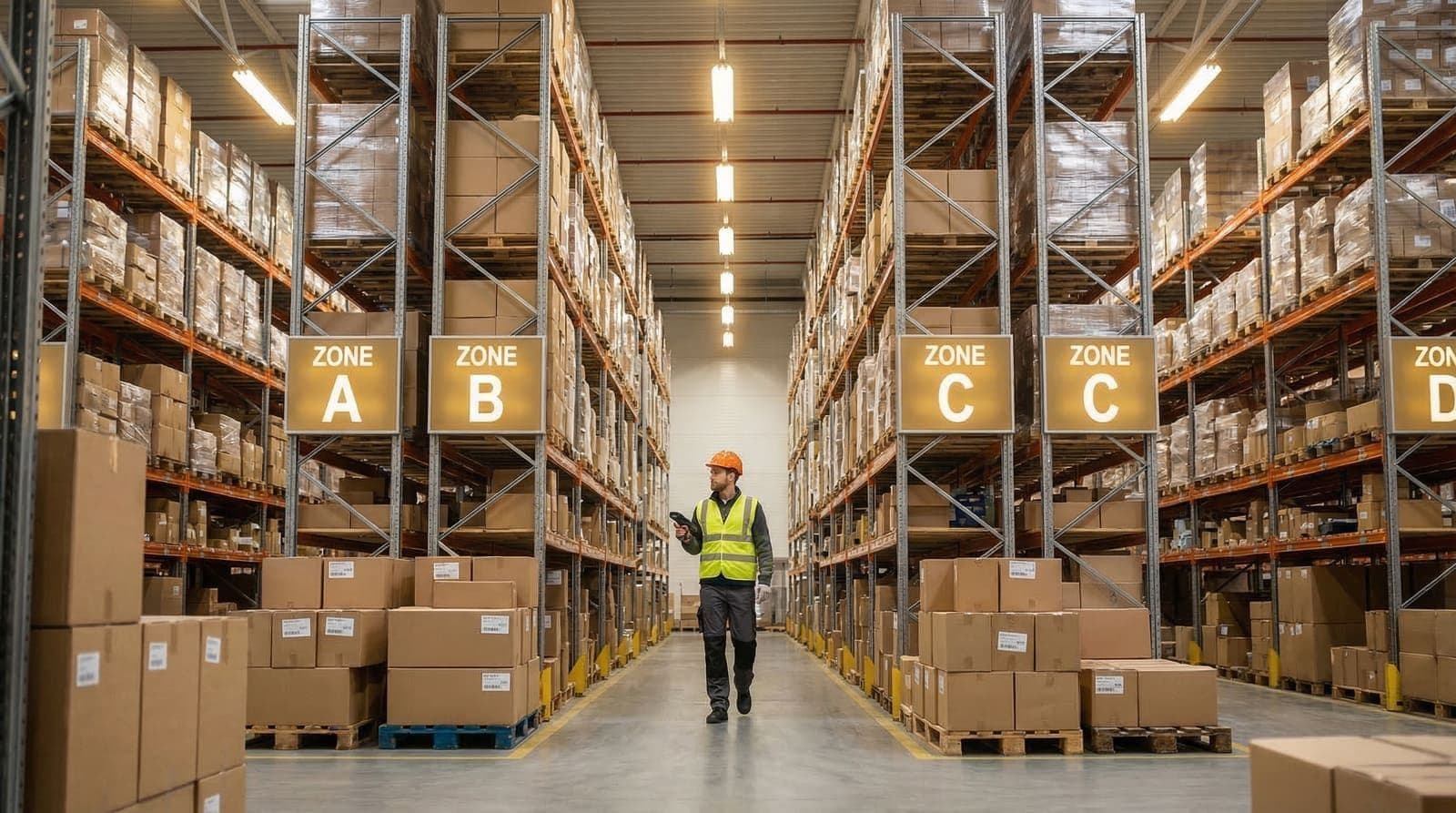
Your warehouse layout might be costing you thousands of hours in wasted travel time every year. The culprit? Poor slotting—the science of deciding where each product lives in your facility.
Most warehouses slot products once and forget about them. But as your product mix changes, order patterns shift, and seasonal demand fluctuates, that initial layout becomes increasingly inefficient. Pickers walk extra miles, fast-movers end up in back corners, and your productivity numbers tell the story.
Here's the good news: warehouse slotting optimization doesn't require expensive automation or warehouse redesigns. It requires data, methodology, and consistent execution.
What Is Warehouse Slotting and Why Does It Matter?
Slotting is the process of determining the optimal storage location for each SKU in your warehouse. Good slotting minimizes travel time, reduces picker fatigue, improves pick accuracy, and maximizes space utilization.
The math is simple but powerful. If your average picker walks 10 miles per shift and you can reduce that to 7 miles through better slotting, you've gained 30% more picking capacity with the same labor force. At a facility with 20 pickers, that's like adding 6 workers without increasing payroll.
Consider a real scenario: A 3PL fulfillment center discovered that their top 100 SKUs (representing 60% of picks) were scattered across three aisles. After re-slotting those items into a single "golden zone" near packing stations, pick rates jumped from 85 to 120 units per hour—a 41% improvement.
The ABC Analysis: Your Starting Point
The foundation of warehouse slotting optimization is ABC analysis, also called velocity-based slotting. Here's how it works:
A-Items (Fast Movers) → 20% of SKUs, 80% of picks
These belong in prime real estate: eye-level positions, closest to pack stations, easiest access. Every extra step to reach an A-item multiplies across thousands of picks.
B-Items (Medium Movers) → 30% of SKUs, 15% of picks
Secondary positions, still reasonably accessible. These might be on lower or higher shelves in prime aisles, or in adjacent zones.
C-Items (Slow Movers) → 50% of SKUs, 5% of picks
These can live in back corners, high shelves, and hard-to-reach spots. The occasional long walk to retrieve them doesn't significantly impact overall productivity.
But here's where many warehouses fail: they do ABC analysis once and consider it done. Velocity patterns shift constantly. A monthly or quarterly re-analysis is essential for maintaining optimal slotting.
Beyond Velocity: Multi-Factor Slotting Strategies
Velocity alone doesn't tell the whole story. Smart slotting considers multiple factors:
Family Grouping
Products frequently ordered together should live near each other. If customers typically order Widget A with Widget B, slot them in adjacent locations. This reduces travel within each order.
Analyze your order data to identify product affinities. A simple co-occurrence matrix showing which SKUs appear together on orders will reveal grouping opportunities.
Physical Characteristics
Heavy items belong at waist height to reduce injury risk and handling time. Fragile items need protected positions. Large items might require floor-level or pallet positions regardless of velocity.
Your warehouse receiving inspection process should capture these characteristics, feeding the data your slotting decisions need.
Ergonomic Considerations
The fastest pick positions aren't always the ones closest to the door—they're the ones that minimize reaching, bending, and lifting. The "golden zone" typically runs from knee height to shoulder height, directly in front of the picker.
Placing your highest-velocity items in this zone multiplies the efficiency gains. Slower items can occupy floor-level and overhead positions where the occasional awkward reach doesn't compound into thousands of inefficient picks.
Seasonal and Promotional Awareness
That sunscreen sitting in a back corner during winter needs prime placement by April. Holiday gift items should migrate to the golden zone starting in October. Promotional items for an upcoming sale need temporary repositioning.
Build seasonal slotting into your planning calendar. The warehouses that anticipate demand shifts outperform those that react to them.
The Golden Zone: Your Highest-Value Real Estate
Your golden zone—typically the area closest to packing stations at ergonomically optimal height—is limited real estate. Treat it that way.
Here's a practical framework for golden zone management:
→ Top 5% of SKUs by velocity: Must be in the golden zone
→ Next 15%: Should be in golden zone or immediately adjacent
→ Heavy items regardless of velocity: Waist-height in the golden zone
→ Remaining SKUs: Distributed by velocity in secondary zones
Some operations take this further with micro-zoning, creating a "platinum zone" within the golden zone for the top 1% of SKUs. In high-volume e-commerce fulfillment, those 10-20 SKUs might represent 25% of all picks.
Slotting for Pick Path Optimization
Where products sit matters, but so does the sequence in which pickers visit them. Effective slotting works in concert with pick path optimization.
Consider your picking methodology:
Zone Picking: Each picker owns a zone. Slot by velocity within each zone, but also balance workload across zones so no single zone becomes a bottleneck.
Wave Picking: Orders are batched into waves. Slot based on order patterns, grouping frequently co-occurring items.
Batch Picking: Multiple orders picked simultaneously. Golden zone placement matters most here since pickers visit it on nearly every batch.
Your order picking productivity depends heavily on the relationship between slotting and pick path design. Optimize them together, not separately.
Forward Pick vs. Reserve: The Two-Tier Approach
Most warehouses operate with forward pick locations (where pickers pull from) and reserve storage (bulk inventory). Slotting applies primarily to forward pick, but the relationship between the two matters.
Forward Pick Optimization
- Right-size forward locations based on velocity and replenishment frequency
- High-velocity items need larger forward positions to reduce replenishment trips
- Low-velocity items might not need forward positions at all
Reserve Positioning
- Keep reserve stock for high-velocity items close to their forward locations
- Reduce replenishment travel time by strategic reserve placement
- Consider warehouse space utilization when designing your reserve-to-forward ratio
A common mistake: allocating identical forward space to all SKUs. Your A-items might need 3-4 cases in forward pick while C-items only need a few units. Dynamic slotting accounts for this variance.
Measuring Slotting Effectiveness
You can't improve what you don't measure. Key metrics for slotting optimization include:
Travel Time Per Pick: Your north star metric. Track average distance and time between picks.
Pick Rate (Units Per Hour): Should increase after slotting optimization. Compare before/after by picker and zone.
Replenishment Frequency: Poorly sized forward positions mean excessive replenishment trips. Track by SKU.
Touches Per Unit: How many times is each unit handled? Good slotting minimizes touches from receiving to shipping.
Golden Zone Utilization: What percentage of your fast movers actually live in prime positions? Aim for 90%+.
Review these warehouse labor productivity metrics weekly after any slotting change. The numbers will tell you if your optimization worked.
The Continuous Slotting Cycle
Slotting isn't a project—it's a process. Build these practices into your operation:
Weekly: Review any SKUs with dramatic velocity changes. New products or promotional items may need immediate repositioning.
Monthly: Run ABC analysis. Identify SKUs that have shifted categories and flag them for potential moves.
Quarterly: Comprehensive slotting review. Analyze pick path data, replenishment patterns, and productivity trends. Execute larger-scale repositioning.
Seasonally: Proactive slotting for known demand shifts. Don't wait for Q4 to reposition holiday items.
Getting Started: A Practical Roadmap
If your warehouse hasn't optimized slotting recently, here's how to start:
- Pull 90 days of order data to establish current velocity patterns
- Map your current layout noting golden zone boundaries and pick paths
- Run ABC analysis categorizing every SKU by pick frequency
- Identify the biggest mismatches: A-items in poor positions and C-items in prime spots
- Prioritize the top 50 moves that will have the largest impact
- Execute during a slow period when disruption is manageable
- Measure results comparing productivity before and after
Most warehouses find that just optimizing their top 100 SKUs delivers 60-70% of the potential gains. You don't need perfect slotting everywhere—start with the moves that matter most.
Making Slotting Work Long-Term
The warehouses that maintain optimal slotting share a few characteristics: they treat it as ongoing operations discipline, not a one-time project. They use data, not intuition, to make slotting decisions. And they build slotting reviews into their regular operational cadence.
At Sizelabs, we've seen how accurate dimensional and weight data feeds into better slotting decisions—understanding the physical characteristics of every SKU helps you place them optimally. Combined with velocity data from your WMS, you have everything you need to build a continuously optimized warehouse layout.
Start with your top 100 SKUs. Measure the impact. Then keep going.