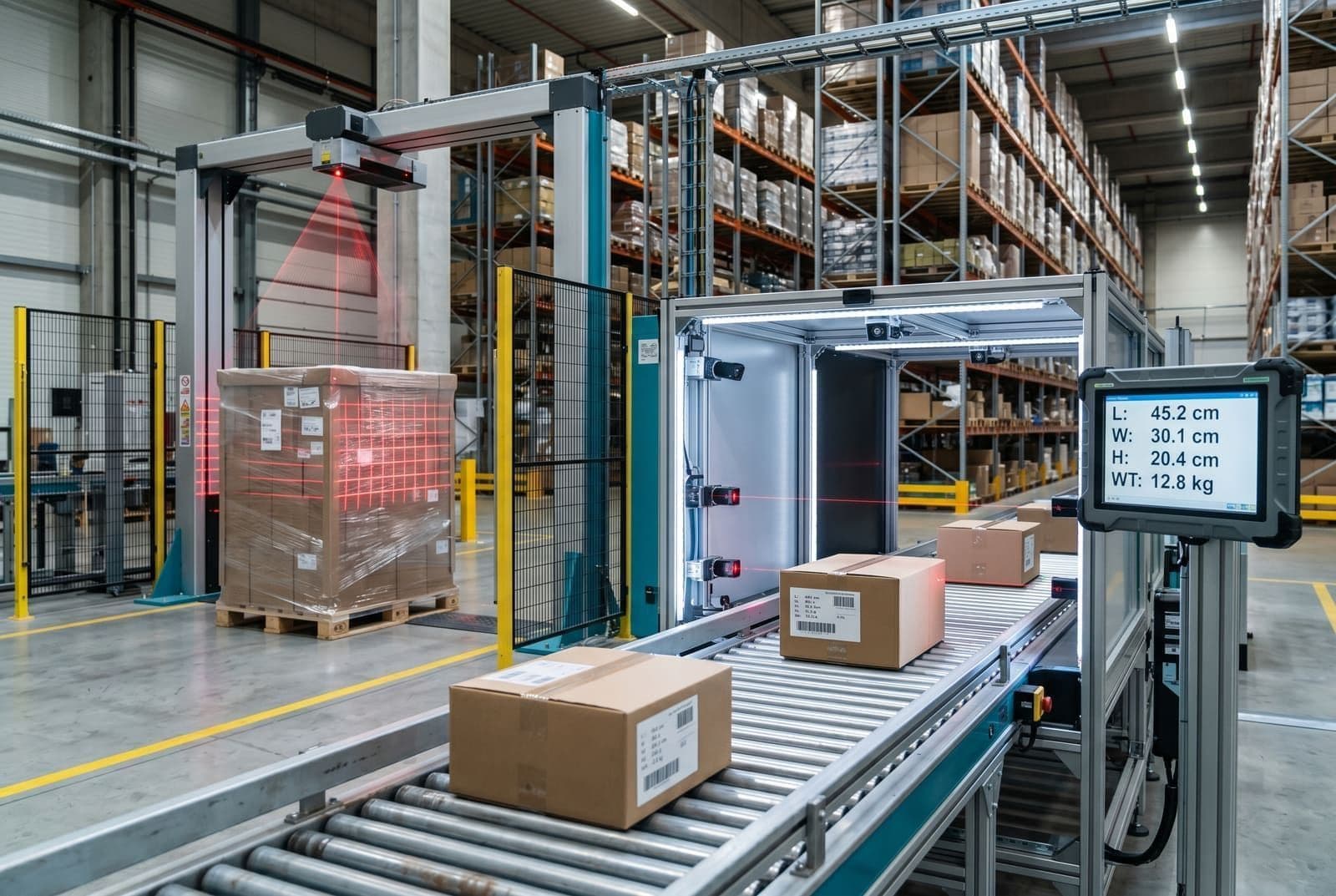
How to Choose a Freight Dimensioning System: A 2026 Buyer's Guide
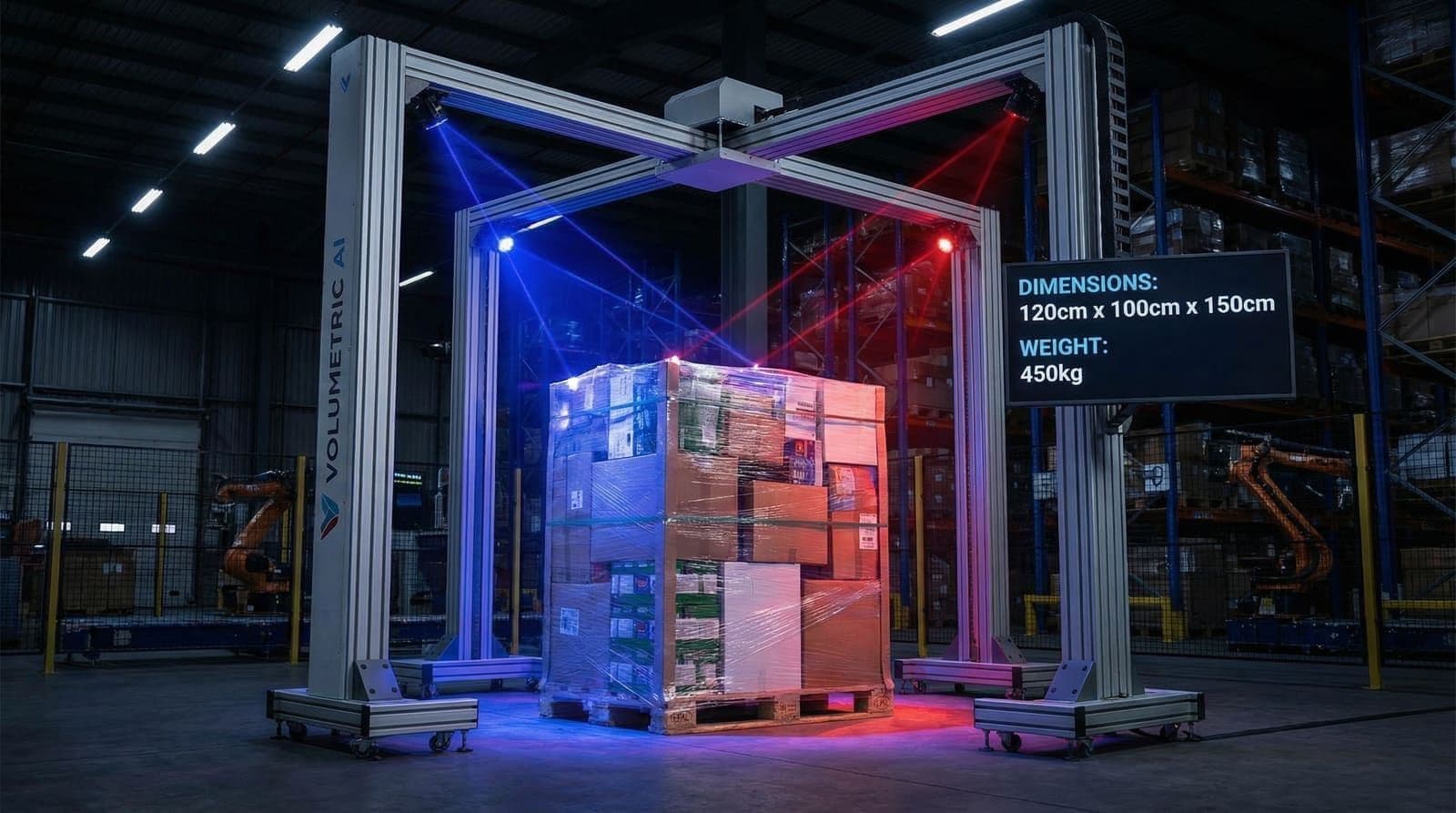
Most dimensioning content focuses on parcel—small packages moving fast through e-commerce fulfillment centers. But if you're handling LTL shipments, oversized freight, or irregular cargo, parcel dimensioning systems won't cut it.
Freight dimensioning operates in a different world: larger measurement envelopes, heavier loads, irregular shapes, and different accuracy tolerances. The buying criteria shift accordingly.
This guide walks through what actually matters when evaluating freight dimensioning systems—and what vendors often gloss over.
Why Freight Dimensioning Is Different
Parcel dimensioners typically handle items up to 36" x 36" x 36" and maybe 150 pounds. Freight dimensioners need to capture:
- Full pallets (48" x 40" x 72" or larger)
- Crated machinery and equipment
- Irregular shapes that don't fit neatly in a box
- Loads weighing 2,500+ pounds
The technology stack changes too. Where parcel systems rely on tight camera angles and conveyor integration, freight systems often use overhead sensors, floor-mounted scales, and larger capture zones that accommodate forklift placement.
If your freight forwarding operation processes mixed cargo—some palletized, some loose, some crated—your dimensioning system needs flexibility that parcel-focused solutions simply don't offer.
Step 1: Assess Your Freight Mix
Before talking to vendors, document what you're actually moving:
Size distribution
- What's your smallest typical freight piece? (Many operations handle both pallets and smaller LTL shipments)
- What's your largest? (Oversized freight that exceeds standard pallet dimensions)
- What percentage falls into each size category?
Shape complexity
- How much of your freight is regular (boxes, standard pallets)?
- How much is irregular (machinery, rolled goods, triangular crates)?
- Do you handle cylindrical items like drums or pipes?
Daily volume
- Peak throughput requirements (pieces per hour during busy periods)
- Average daily volume
- Seasonal variation (do you need a system that scales?)
This assessment directly impacts which measurement technology makes sense. High-volume operations with mostly regular shapes can use simpler sensor arrays. Low-volume operations with complex shapes might need more sophisticated 3D capture.
Step 2: Define Your Accuracy Requirements
Freight dimensioning accuracy requirements differ significantly from parcel:
Legal-for-trade applications
If you're billing carriers or customers based on dimensional weight, you likely need NTEP-certified equipment. The National Type Evaluation Program certifies that measurement devices meet specific accuracy standards for commercial transactions.
For freight, this typically means:
- ±0.5" accuracy on each dimension
- Certified scale integration for weight
- Audit trail documentation
Not sure whether certification matters for your use case? Our breakdown of NTEP certification requirements explains when it's legally necessary versus nice-to-have.
Internal operations applications
If dimensioning data feeds warehouse management rather than billing, accuracy requirements shift. You might prioritize:
- Speed over precision (±1" might be acceptable)
- Ease of use for operators
- Lower total cost
The key question: Who receives the dimensional data, and what decisions depend on it?
Step 3: Evaluate the Measurement Envelope
Every dimensioning system has minimum and maximum measurement limits. For freight, pay attention to:
Maximum dimensions
- Can it measure your largest standard pallet fully loaded? (Many systems cap at 72" height)
- What about oversized items that exceed pallet dimensions?
- Does accuracy degrade at the edges of the measurement range?
Minimum dimensions
- Can it accurately measure smaller LTL pieces?
- Is there a minimum size threshold where the system loses accuracy?
Weight capacity
- What's the maximum load the integrated scale supports?
- Is the scale certified for commercial use?
- How does the system handle loads that exceed capacity?
Floor space requirements
- How much clearance does the measurement zone need?
- Can forklifts safely maneuver around the installation?
- Does the system require special flooring or foundations?
A system that handles 95% of your freight but fails on the largest 5% creates operational headaches—those oversized pieces still need documentation.
Step 4: Consider the Operator Experience
Freight dimensioning involves forklifts, heavy equipment, and busy dock workers who don't have time for complicated procedures. The system needs to work within existing workflows, not against them.
Capture method
- Drive-through: Forklift passes through a measurement gate. Fast but requires specific traffic patterns
- Static placement: Forklift positions freight on a platform for measurement. More flexible but slower
- Handheld augmentation: Mobile devices capture irregular items that automated systems struggle with
Feedback and guidance
- How does the operator know the measurement succeeded?
- What happens when measurement fails? Clear guidance or cryptic errors?
- Can operators easily re-measure if needed?
Training requirements
- How long until new operators are proficient?
- Does the system accommodate varying skill levels?
- What documentation and support is available?
Operations that manage warehouse productivity closely should factor operator time-per-measurement into ROI calculations. A $10,000 cheaper system that adds 30 seconds per measurement costs more over time.
Step 5: Check Integration Capabilities
Dimensional data sitting in a standalone system provides limited value. The data needs to flow:
WMS integration
- Does the vendor offer pre-built connectors for major WMS platforms?
- What's the data format (API, file export, direct database)?
- How real-time is the integration?
TMS and carrier billing
- Can dimensional data feed directly to transportation management systems?
- Does the system support carrier-specific billing formats?
- How does it handle rate calculations?
ERP and financial systems
- Can measurement data support invoicing workflows?
- Are audit records exportable for compliance?
For operations running carrier compliance programs, integration quality directly impacts dispute resolution. Systems that produce detailed, timestamped records with images make winning billing disputes straightforward.
Step 6: Calculate Total Cost of Ownership
Freight dimensioning systems typically cost more upfront than parcel equivalents, but the TCO calculation involves more than hardware:
Initial costs
- Hardware (sensors, cameras, scales, mounting)
- Installation and site preparation
- Integration development/configuration
- Training
Ongoing costs
- Annual maintenance and calibration
- Software licensing (many vendors charge annually)
- Support and service contracts
- Replacement parts and upgrades
Hidden costs to ask about
- Recertification frequency for legal-for-trade systems
- Integration maintenance when WMS versions change
- Downtime during calibration or service
A five-year TCO view often reveals that the cheapest initial quote isn't the lowest total cost. For a deeper dive into cost modeling, see our dimensioning system TCO breakdown.
Step 7: Evaluate Vendor Viability
Freight dimensioning is a long-term infrastructure investment. The vendor needs to be around for the system's lifespan:
Company stability
- How long have they been in business?
- What's their install base for freight-specific systems?
- Do they have references in your industry?
Support infrastructure
- Where is technical support located?
- What's the typical response time for critical issues?
- Do they offer on-site service, or is everything remote?
Product roadmap
- How frequently do they release updates?
- Are they investing in the technology, or is it maintenance mode?
- Do they offer upgrade paths as your needs evolve?
Red Flags to Watch For
Vendor conversations often reveal warning signs if you know what to listen for:
"Our parcel system works fine for freight"
Maybe, but probe deeper. What's the actual measurement envelope? How do they handle irregular shapes? Most parcel systems that "also do freight" are compromises.
Vague accuracy specifications
If a vendor can't clearly state accuracy at different points in the measurement envelope, they either don't know or don't want to tell you.
No reference customers in similar operations
Every operation is different, but a vendor with zero freight customers is asking you to be their test case.
Integration "available upon request"
This usually means custom development at your expense. Ask for specific connector documentation before signing.
Calibration requirements that seem excessive
Some systems need recalibration weekly; others annually. Understand what's driving the frequency—it often signals design quality.
Making the Decision
After evaluating options against these criteria, the final decision often comes down to:
- Does it handle your freight mix? Not theoretically, but demonstrably—ideally with your actual freight during a pilot
- Does it integrate with your systems? Proof of integration, not promises
- Can your team operate it efficiently? Real feedback from operators who tested it
- Is the TCO sustainable? Five-year cost projection, not just purchase price
- Do you trust the vendor? References, responsiveness, and realistic expectations
Getting Started
If you're evaluating freight dimensioning systems, start by documenting your freight mix and volume. The more specific data you bring to vendor conversations, the more useful their proposals will be.
Sizelabs works with freight operations across 3PLs, forwarders, and distribution centers. Our Wilkins Pallet Dimensioner system handles the full range of freight dimensioning needs, from standard pallets to irregular cargo, with WMS integration built in rather than bolted on.
Whether you're replacing an aging system or dimensioning freight for the first time, the right solution exists—you just need to ask the right questions.