Parcel Dimensioning ROI: How to Build the Business Case Before You Buy
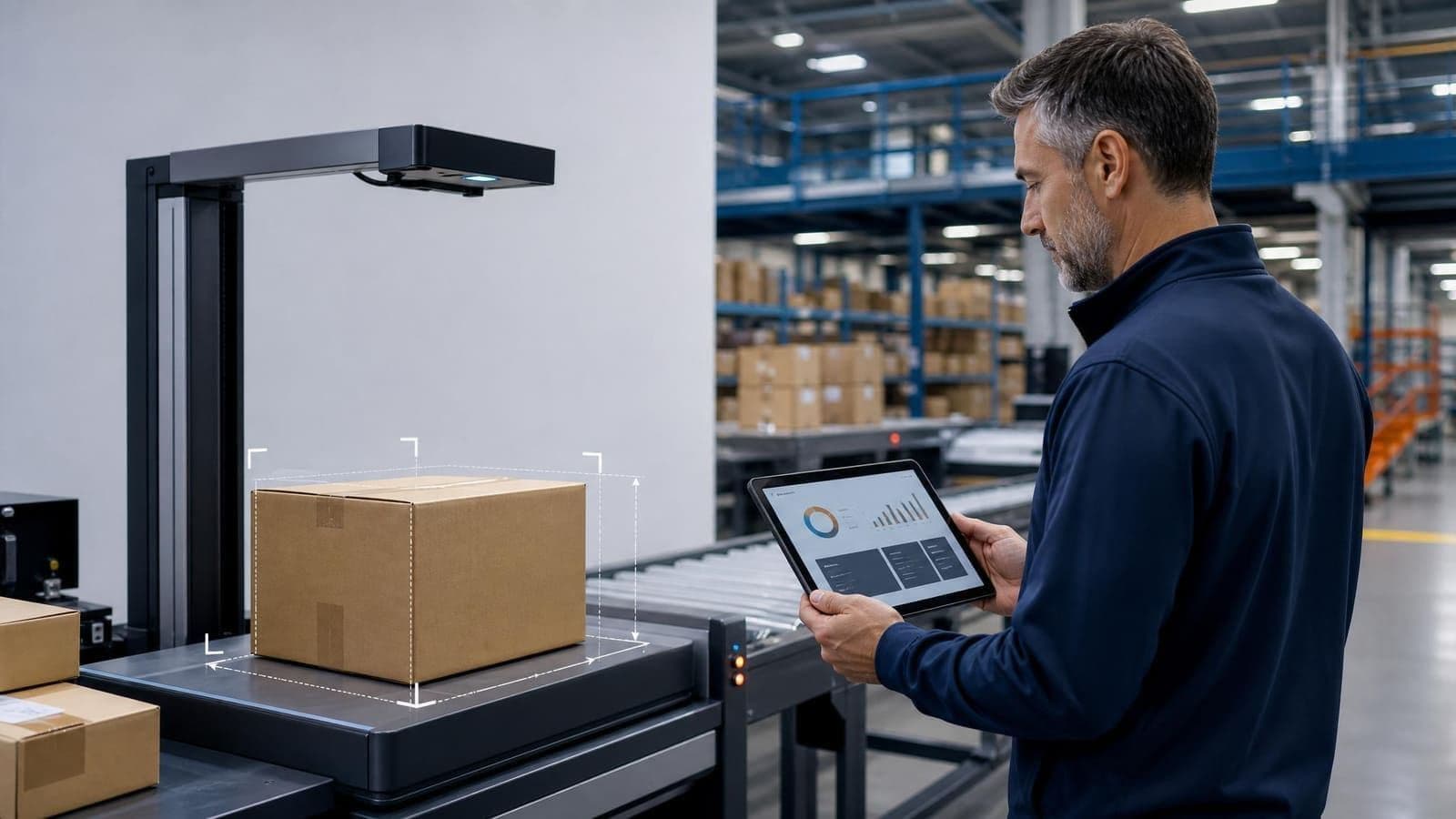
A parcel dimensioning ROI case should not start with the device price. It should start with the decisions your warehouse makes with parcel dimensions: rating, manifesting, carton selection, audit, customer billing, carrier dispute response, and shipment proof.
When those dimensions are missing, late, or unreliable, the cost shows up in different places. Operators measure manually. Carriers apply dimensional weight adjustments. Finance researches invoices without proof. Customer service argues from incomplete shipment records. Packaging teams keep guessing which carton rules are actually working.
That is why a strong business case separates the value streams. Parcel dimensioning may save labor, but labor is rarely the whole story. The bigger ROI often comes from fewer billing surprises, cleaner shipping data, faster audit response, and better control over parcel spend.
Here is how to build a practical ROI model before buying a parcel dimensioning system.
Start parcel dimensioning ROI with the workflow, not the equipment
The same dimensioner can support several workflows, but the ROI changes depending on where the measurement happens.
For example:
- Pack-out measurement: dimensions are captured before label creation, so the system can support rating, service selection, and manifest accuracy.
- Manifest audit: packages are checked before carrier pickup to catch missing dimensions, overweight parcels, or dimensional weight exposure.
- Exception station: only questionable shipments are measured, usually because the carton looks oversize, the weight is inconsistent, or the account has billing risk.
- Master data capture: item or package dimensions are collected to improve cartonization, slotting, storage planning, or future order planning.
- Dispute documentation: images, dimensions, weight, timestamps, and identifiers are stored so finance can challenge or validate carrier adjustments later.
Do not blend all of these into one vague automation case. Write the first use case clearly: "We want to capture parcel dimensions at pack-out before manifest close so we can reduce manual measurement, lower dimensional weight adjustments, and improve invoice audit evidence."
That sentence defines what to measure. It also prevents the buying process from drifting into features that look impressive but do not change the business result.
If the operation is still deciding where the system belongs, review the station questions in our guide to choosing a parcel dimensioning system for manifest and audit stations. Placement is not a detail. It determines which value streams the system can realistically affect.
Measure the current baseline before estimating savings
A parcel dimensioning ROI model fails when the baseline is guessed.
Before using vendor assumptions, capture a short but representative baseline from your own operation. Include normal days, peak periods if possible, and the parcel profiles that create the most billing or handling problems.
Useful baseline data includes:
- parcels shipped per day and per shift
- percentage of parcels measured manually
- average manual measurement time per parcel
- number of operators involved in measuring, rating, correcting, or researching shipments
- frequency of dimensional weight adjustments
- adjustment dollars by carrier, service, customer, product family, or carton type
- time spent researching carrier invoices and disputes
- percentage of shipments with complete dimensions, weight, image, and tracking data
- rework caused by missing or conflicting shipment data
- cartons or package profiles that repeatedly create billing surprises
The goal is not perfect accounting. The goal is enough evidence to build a finance-ready range instead of a hopeful estimate.
For labor, time a sample of real work. Do not use the fastest clean carton as the average. Include awkward cartons, label problems, rescans, supervisor questions, and packages that operators measure twice because they do not trust the first result.
For carrier adjustments, look beyond total adjustment dollars. Group them by cause. A dimensioning system can help with missing or inaccurate dimensions, but it will not fix every surcharge, address correction, residential fee, delivery area charge, or service-level mistake. Keep the model honest.
Quantify labor savings without overstating them
Labor savings are the easiest part of parcel dimensioning ROI to explain, but they are also easy to exaggerate.
A basic labor model looks like this:
- parcels measured manually per day
- average seconds spent measuring and recording each parcel
- working days per year
- fully loaded labor cost per hour
- percentage of that work the system will remove
For example, a warehouse that manually measures 700 parcels per day at 35 seconds each is spending roughly 6.8 labor hours per day on that task. At 250 shipping days per year, that is about 1,700 annual labor hours before supervision, rework, and invoice research.
But the savings should be adjusted for reality. Some operator time may shift to scanning, exception handling, or station loading. If the dimensioner removes 70% of manual measurement effort, model 70%, not 100%. If the process still requires manual intervention for irregular packages, make that visible.
Also ask where the saved time will go. The ROI is stronger when labor reduction converts into a specific operational benefit:
- fewer people needed at manifest during peak
- more parcels processed before carrier cutoff
- less overtime during promotion periods
- fewer supervisor interruptions
- more time for quality checks, packing, or exception resolution
Finance will trust the case more if it shows operational redeployment instead of pretending every saved second becomes immediate headcount reduction.
Separate carrier adjustment avoidance from dispute recovery
Carrier billing value usually comes from two different sources: preventing adjustments and improving dispute recovery.
They are related, but they should be modeled separately.
Avoided adjustments happen when accurate dimensions are captured before rating or manifest close. The shipment is rated with better data, carton rules can be corrected, and the carrier is less likely to apply a surprise dimensional weight correction later.
Dispute recovery happens after an adjustment appears. The warehouse can use captured dimensions, weight, images, timestamps, and shipment identifiers to validate the charge or challenge it with evidence.
A useful parcel dimensioning ROI model asks:
- Which adjustment types are caused by missing or inaccurate dimensions?
- How many of those adjustments would better pre-shipment data prevent?
- Which adjustments would still happen but become easier to dispute?
- What percentage of disputed dollars are currently recovered?
- How much staff time is spent researching disputes without proof?
- Which carriers, services, accounts, or package profiles create the highest exposure?
This is where dimensioning data can support transportation and finance, not only warehouse operations. If the system reduces preventable adjustments by a modest percentage and improves recovery on the remaining disputes, the combined value can be material.
For operations that see frequent invoice surprises, this connects directly to carrier billing disputes and warehouse dimensioning. The strongest case is not "we will have better data." It is "we will prevent these specific charges and resolve these specific disputes faster."
Include data quality benefits that affect other teams
Parcel dimensions do not only matter at shipping.
Better dimensioning data can improve decisions upstream and downstream:
- Cartonization: actual package dimensions reveal whether carton rules are choosing the right box or creating dimensional weight waste.
- Slotting and storage: reliable item or packed-order dimensions can improve space planning and pick face decisions.
- Customer billing: 3PLs and fulfillment providers can support more accurate freight pass-through, accessorial billing, or shipment proof.
- Carrier negotiation: shipment profiles with real dimensions help transportation teams negotiate from evidence rather than averages.
- Packaging improvement: repeated oversize or air-shipping patterns become easier to identify.
- Exception management: shipments with missing, inconsistent, or high-risk data can be routed before pickup instead of discovered on the invoice.
These benefits are harder to put into a simple payback calculation, but they should not be ignored. They often explain why the system matters to more than one department.
The key is to avoid vague claims. Do not write "better data improves operations" in the business case. Write what better data will change.
For example:
- "We will review the top 25 carton profiles by dimensional weight exposure every month."
- "We will flag customer accounts where billed parcel dimensions differ from carrier-adjusted dimensions by more than a defined threshold."
- "We will feed measured package dimensions into cartonization analysis before changing box rules."
- "We will store image proof for high-value or high-dispute shipments for invoice audit."
That turns data quality into operating discipline.
Build the cost side beyond device price
A buyer-ready parcel dimensioning ROI model must include the real cost to make the system work.
Common cost categories include:
- dimensioning equipment and accessories
- scale, scanner, printer, stand, conveyor, or workstation changes
- software subscription or license fees
- implementation services
- WMS, TMS, shipping software, or ERP integration
- image storage or data retention requirements
- network, power, or physical layout work
- training and change management
- maintenance, calibration, support, and spare parts
- internal IT, operations, and project management time
- future stations if the rollout expands
This does not mean the model has to be pessimistic. It means the payback estimate should survive scrutiny.
A system that appears to pay back in six months on device price alone may look different after integration, station redesign, and support are included. On the other hand, a system that looks expensive at first may still pay back quickly if it prevents large adjustment dollars, protects peak throughput, and gives finance stronger dispute evidence.
The right question is not "what is the cheapest dimensioner?" The better question is: which implementation creates the most reliable return for the workflow we need to improve?
Define proof metrics before the pilot
The business case should tell the pilot what to prove.
Before buying, define the metrics that will confirm whether the parcel dimensioning ROI is real:
- manual measurement seconds per parcel before and after
- parcels processed per labor hour at the station
- percentage of shipments with complete dimensions, weight, image, and identifier data
- dimensional weight adjustment rate by carrier and service
- adjustment dollars per 1,000 parcels
- invoice research time per dispute
- dispute recovery percentage for dimension-related adjustments
- percent of exceptions resolved before pickup
- station uptime and operator bypass rate
- number of carton or packaging rules changed from measured data
These metrics should be reviewed during the dimensioning system pilot, not after a full rollout. If the pilot cannot prove the main value streams, either the workflow design is wrong, the data is not reaching the right system, or the ROI assumption needs to change.
That is good to learn early. A practical pilot should sharpen the business case, not simply confirm the purchase everyone already wanted.
Make the ROI case conservative enough to trust
The best parcel dimensioning ROI cases are not inflated. They are specific, conservative, and tied to operating changes the warehouse can actually execute.
A strong case says:
- here is the workflow we are improving
- here is the current cost of manual work, adjustments, disputes, and poor data
- here is what the system is expected to change
- here is the cost to implement and support it
- here are the metrics we will use to prove value
- here is the payback range under conservative, expected, and upside scenarios
That structure makes the buying conversation easier for operations, finance, transportation, and IT. Everyone can see which assumptions matter and which results must be measured.
Sizelabs helps warehouse teams connect parcel dimensioning to the business decisions that create ROI: manifest accuracy, billing control, dispute evidence, shipment proof, and data quality. If you are building the case, start with the costliest parcel decisions in your operation, then measure whether better dimensions will change them enough to justify the investment.