Warehouse Dock Door Utilization: How to Keep Doors Moving Without Adding Space
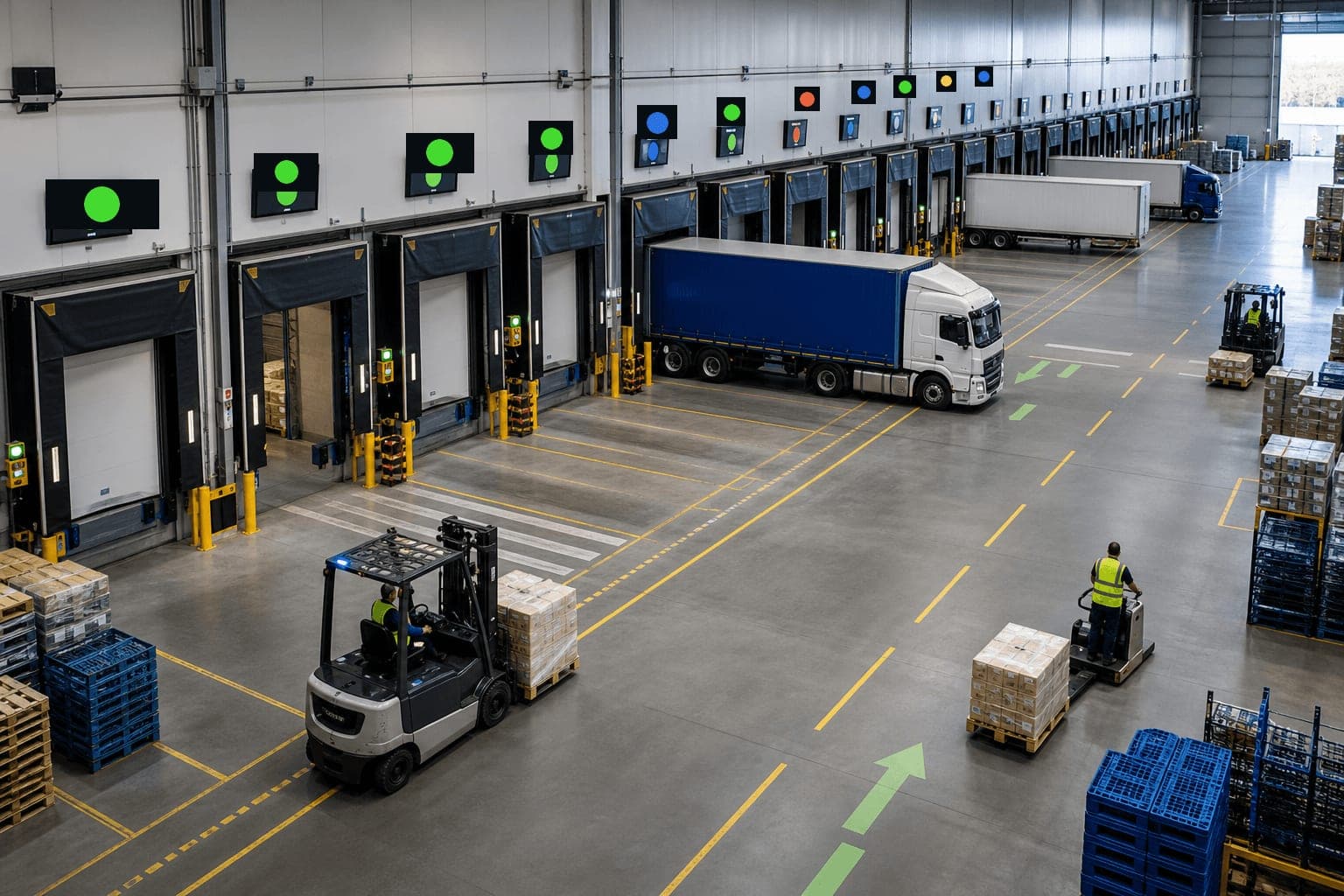
Warehouse dock door utilization is not just a real estate metric. It is a flow metric.
A door can look busy all day and still be poorly used. A trailer may sit at the door waiting for paperwork. A receiver may be ready, but the freight has no ASN or purchase order match. A shipping door may be blocked by staged freight that is not actually ready to load. A carrier may arrive on time, but the warehouse does not have labor or equipment available.
When that happens, the building starts treating dock doors as storage, waiting rooms, and exception areas. The result is predictable: longer dwell time, more detention risk, missed carrier pickups, crowded staging lanes, and supervisors trying to solve every delay at the most constrained point in the warehouse.
Improving warehouse dock door utilization starts by understanding what each door is doing, why it is blocked, and whether the surrounding process is ready before a trailer backs in.
Measure warehouse dock door utilization by status, not occupancy
Door occupancy alone can be misleading.
If all doors are occupied, the operation may assume it has a capacity problem. But the useful question is: what is each occupied door actually doing?
Separate door time into clear statuses:
- Actively loading or unloading: freight is moving and the door is producing throughput
- Waiting on labor: the trailer is present, but no crew or equipment is assigned
- Waiting on paperwork: bills of lading, packing lists, ASNs, purchase orders, labels, customs documents, or carrier documents are not ready
- Waiting on staging: outbound freight is not picked, packed, manifested, sequenced, or released
- Waiting on inspection: inbound freight needs damage review, count verification, quality hold, or supervisor approval
- Waiting on system transactions: WMS, TMS, shipping platform, label, or integration work is blocking movement
- Waiting on carrier action: driver check-in, drop-and-hook timing, seal control, yard movement, or appointment issues are delaying the turn
This status view changes the conversation. A door occupied for 90 minutes may be healthy if the team is unloading a full floor-loaded container. A door occupied for 35 minutes may be a problem if 25 of those minutes were waiting for labels or a forklift.
The goal is not to force every door to turn at the same speed. Different freight profiles require different handling. The goal is to stop confusing productive door time with preventable waiting time.
Assign doors by workflow requirements
Many dock problems begin before the truck arrives.
If doors are assigned casually, the warehouse discovers constraints too late: the wrong equipment is nearby, the staging lane is full, a live unload blocks a door needed for a scheduled carrier pickup, or a high-priority receipt lands where the putaway team cannot support it.
A stronger door plan considers the work behind each appointment:
- Inbound receiving: vendor, PO priority, ASN quality, pallet count, floor-loaded freight, inspection needs, temperature or hazmat requirements, and putaway urgency
- Outbound shipping: carrier cutoff, route sequence, parcel, LTL, full truckload, customer priority, trailer type, seal requirements, and manifest readiness
- Cross-dock freight: unload-to-load timing, destination route, staging capacity, relabeling, and whether freight can move directly without reserve storage
- Returns: inspection space, disposition rules, photo documentation, quarantine, and whether returns should compete with normal receiving doors
- Exception-heavy work: damaged freight, blind receiving, mixed pallets, missing labels, oversize items, or shipments requiring supervisor review
Door assignment should also reflect the physical building. A door near outbound staging may be valuable for parcel or LTL pickup but poor for slow inbound inspection. A door close to quality control may be better for returns or vendor compliance issues. A door with better trailer access may be reserved for live loads during peak windows.
For operations with frequent appointment pressure, this connects directly to dock scheduling. Scheduling decides when trucks should arrive. Door utilization discipline decides whether the warehouse is ready to turn them.
Keep staging from becoming the hidden door constraint
Dock doors do not fail in isolation. They often fail because staging is unclear.
Outbound freight may be physically near the door but not ready to load. Inbound freight may come off the trailer with no clean place to go. Cross-dock freight may need to move quickly, but mixed priorities force operators to sort in the worst possible location.
Use staging rules that make readiness visible:
- Ready to load: picked, packed, labeled, manifested or ready for manifest, and released for the assigned carrier or route
- Ready to receive: appointment confirmed, PO or ASN available, receiving team assigned, putaway or inspection path known
- Waiting on information: missing paperwork, unclear customer status, routing issue, carrier question, or purchase order mismatch
- Quality or damage hold: freight requiring inspection, photos, claim documentation, quarantine, or disposition
- Sequence-controlled: freight that must load or unload in a specific order because of route, stop, weight, fragility, or customer rules
The dock door should not be the place where the operation figures out what freight is. If the team is sorting, researching, relabeling, and staging at the door, the door is being used as a problem-solving desk instead of a throughput point.
A practical rule is: ready freight moves to the door; unresolved freight moves sideways. Sideways means it goes to a defined exception lane with an owner, reason, timestamp, and next action. That keeps the door available for work that can actually move.
Align labor and equipment with the door plan
Door utilization drops when the schedule assumes capacity that the labor plan cannot support.
A building may have enough physical doors and still run short on receivers, loaders, forklift operators, yard drivers, clerks, scanners, pallet jacks, stretch-wrap capacity, or supervisor attention. The constraint is not the door. It is the support system around the door.
Build the daily labor plan around the door plan:
- Which appointments require live unload crews?
- Which outbound pickups need loaders protected before carrier cutoff?
- Which doors need forklift support versus pallet jack work?
- Which inbound loads need receiving clerks, quality staff, or inventory control?
- Which trailers can drop and wait, and which must turn immediately?
- Which appointment waves create overlapping demand for the same people or equipment?
This is where warehouse dock door utilization connects to warehouse labor planning. If the labor model only looks at total receipts or total orders, it may miss the hour-by-hour door constraint. Five appointments spread across a shift may be easy. Five appointments arriving inside a 45-minute window may break the dock even if daily volume looks normal.
Use simple triggers during the shift. If a door has been waiting on labor for more than a defined threshold, escalate before detention risk builds. If outbound staging is not ready 60 minutes before pickup, decide whether to resequence, move labor, or release a partial load. If a live unload is running longer than expected, update the next appointment before the yard becomes the overflow plan.
Track the reasons doors stop moving
The most useful dock metric is not only turns per door. It is the reason flow stopped.
Review blocked time by cause:
- appointment arrived early, late, or without required information
- inbound paperwork or ASN did not match the freight
- outbound freight was not ready when the carrier arrived
- staging lane was full or mixed with exception freight
- labor or equipment was assigned elsewhere
- trailer was waiting on seal, bill of lading, manifest, or system closeout
- freight needed inspection, rework, relabeling, remeasurement, or damage documentation
- carrier, yard, or gate process delayed the trailer move
Patterns matter more than one-off delays. If one vendor repeatedly blocks receiving doors with poor paperwork, vendor compliance needs attention. If one outbound carrier lane waits every afternoon, pickup timing or release discipline may be wrong. If doors are frequently waiting on system transactions, the issue may be integration, label printing, or WMS process timing.
For broader exception control, use a warehouse exception management process so each recurring blocker has an owner and corrective action instead of becoming another daily supervisor call.
Review dock utilization as a flow problem
Warehouse dock door utilization improves when the team treats doors as scarce flow points, not flexible storage space.
A useful weekly review asks:
- Which doors had the most blocked time?
- What percentage of door time was active loading or unloading?
- Which appointments created the most waiting or rework?
- Which outbound pickups were at risk because freight was not ready?
- Which delays were caused by staging, labor, equipment, paperwork, or systems?
- Which problem happened often enough to deserve a process change?
The answer may not be "add more doors." It may be better appointment discipline, clearer staging, earlier document control, stronger labor alignment, improved yard visibility, or cleaner shipment data before freight reaches the dock.
Adding doors can help when the building has a real physical constraint. But many warehouses can recover capacity first by reducing the time doors spend waiting on decisions that should have happened earlier.
If your dock is crowded even when volume is manageable, Sizelabs can help you look at the measurement, shipment, and workflow data that reveals where freight is getting stuck before the door becomes the bottleneck.