Warehouse Short-Ship Prevention: How to Catch Missing Units Before Manifest
Warehouse short-ship prevention is the set of controls that catches missing units before an order is manifested, loaded, billed, or handed to the carrier.
Short shipments are expensive because they usually show up late. The customer receives an incomplete order. Customer service opens a case. Inventory control researches whether the unit was never picked, picked into the wrong tote, packed into the wrong carton, left at consolidation, damaged, substituted, or shipped under another label. The warehouse may then pay for a reship, credit, expedited freight, or manual investigation.
The best time to prevent that problem is while the order is still inside the building and the evidence is still visible.
For warehouse operators and buyers, the goal is not just better picking discipline. The goal is a controlled outbound workflow that proves what was picked, packed, held, released, and manifested before the order leaves the warehouse.
Find where short shipments enter the workflow
A short shipment can start in several places, so the first step is to map the defect source instead of blaming the last person who touched the order.
Common sources include:
- an item was not available in the forward pick location, but the order kept moving
- a picker confirmed a quantity without scanning each required unit or case
- inventory was substituted, split, or partially allocated without a clear order status
- a tote, cart, or pallet was mixed during zone picking or consolidation
- a value-added step removed an item for labeling, inspection, kitting, or rework
- a packer closed the carton before confirming every expected line
- a carrier label was printed for a shipment that still had an open exception
- a staged order was loaded with one carton missing from the shipment set
The practical test is simple:
If the warehouse cannot prove which units reached the final shipping record, the workflow is relying on memory instead of control.
That does not mean every operation needs a complex system. It means each outbound flow needs a clear point where the order must prove completeness before it can move forward.
Control the scan sequence before pack confirmation
Short-ship prevention depends on scan sequence. The system should not let the operator confirm the shipment before the order identity, item identity, quantity, carton or container, and exception status are known.
For each outbound flow, define the required sequence:
- scan the order, wave, tote, license plate, or shipment
- scan or verify each SKU, lot, serial, case, or unit required by the order
- confirm picked quantity against expected quantity
- confirm the carton, pallet, bag, tote, or shipping unit that will carry the item
- confirm any inserts, documents, labels, customer routing requirements, or value-added work
- capture weight, dimensions, or image evidence when those signals help verify completeness
- block manifest confirmation when a required line is missing, substituted, damaged, or unresolved
The strongest requirement sounds like this:
"The outbound workflow must prevent shipment confirmation until every required item, quantity, carton, operator, station, timestamp, and exception status is tied to the shipment record."
That requirement is more useful than asking for "barcode scanning" because it defines what the scans must prove.
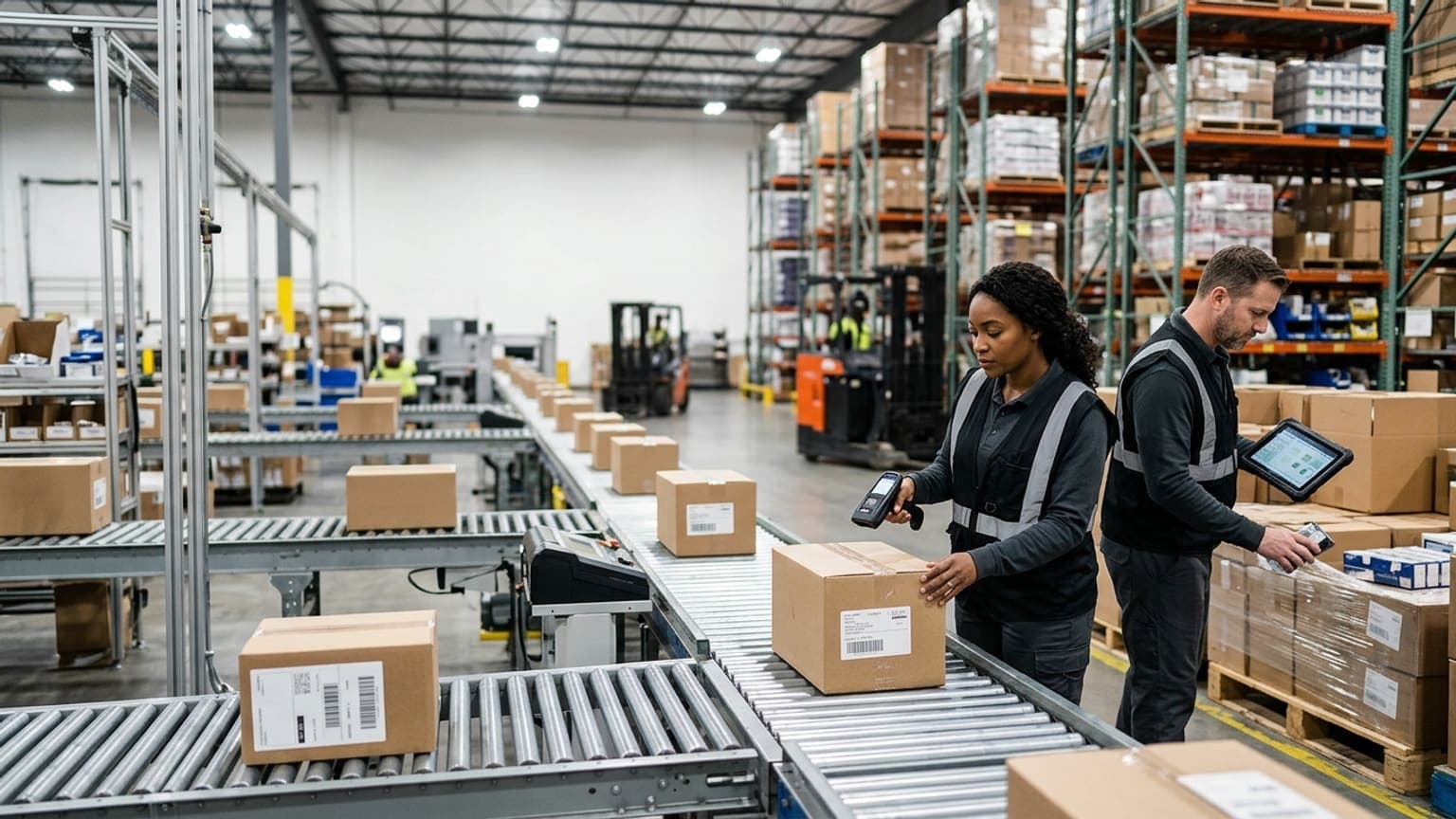
If your team is already reviewing warehouse pack station automation requirements, short-ship controls should sit inside the same decision model. The pack station is not only a label-printing point. It is often the last practical chance to stop an incomplete shipment.
Use weight and dimension checks as exception signals
Weight and dimensions do not replace item confirmation, but they can expose problems that scans miss.
A carton that is materially lighter than expected may be missing a unit, missing dunnage, using the wrong product, or packed in the wrong carton. A shipment with unexpected dimensions may have been overboxed, underpacked, split incorrectly, or packed without a required component. A pallet that does not match the expected profile may be missing cases, built under the wrong shipment, or loaded before all cartons reached staging.
Buyers should define when physical capture is required:
- high-value orders
- multi-line orders with similar SKUs
- orders with customer compliance requirements
- split shipments and multi-carton shipments
- orders with frequent shortage claims
- orders packed after replenishment, inventory, or substitution exceptions
- shipments where freight cost, claims, or customer chargebacks justify evidence
Do not treat every mismatch as a defect. Treat it as a signal.
A useful workflow routes the order to an exception queue when measured weight, dimensions, item count, or image evidence does not match the expected shipment profile. The exception owner can then decide whether to rescan, repack, correct inventory, release the order, split the shipment, or hold it for supervisor review.
For broader exception design, connect this control to your warehouse exception management model so the problem has a reason code, owner, age, and release rule.
Protect carrier cutoff without hiding shorts
Short-ship prevention gets harder near carrier cutoff. When the floor is behind, teams may feel pressure to ship what is ready and fix the rest later.
Sometimes that is the correct commercial decision. A partial shipment may protect a customer promise, preserve a route, or meet a retail window. But it should be a controlled decision, not an accidental one.
Create clear cutoff rules:
- Recoverable before cutoff: the missing unit is available, the owner is assigned, and the order can still ship complete.
- Controlled partial: the business approves a partial shipment, the customer-facing status is updated, and the remaining unit has a backorder, reship, or cancellation path.
- Hold before manifest: the shortage is unclear, the inventory signal is unreliable, or the customer requirement does not allow a partial.
- Escalate immediately: the shipment is high value, compliance-sensitive, customer-critical, or repeatedly short on the same SKU, location, or process.
The important part is visibility. A late-day shortage should not disappear into a staged cart, a chat message, or a manual note on a packing bench.
If cutoff pressure is a recurring cause, review the upstream warehouse shipping cutoff management workflow. A short shipment at 4:45 p.m. is often a planning problem that started hours earlier in replenishment, picking, consolidation, or exception release.
Measure causes, not just claims
Many teams track short shipments only after customers report them. That is too late to improve the operation.
Track the signals while the work is still happening:
- short-ship exceptions created before manifest
- short-ship claims received after delivery
- missing-unit source by picking, replenishment, consolidation, packing, staging, loading, or inventory control
- SKU, location, customer, order type, shift, pack station, and operator patterns
- time from exception creation to release or cancellation
- reship cost, credit value, expedited freight, and customer-service touches
- repeat shortages tied to poor master data, location discipline, or replenishment timing
The strongest KPI is not only the customer-reported short-ship rate. It is the ratio of shorts caught before manifest to shorts discovered after delivery.
If pre-manifest catches rise while customer claims fall, the operation is finding problems earlier. If both rise, the workflow is exposing a deeper inventory or process issue. If customer claims rise while internal exceptions stay flat, the warehouse may not be checking the right control points.
Conclusion: complete orders need proof, not hope
Warehouse short-ship prevention works when the outbound process can prove completeness before the order leaves control of the building.
Start by finding where shortages enter the workflow. Control scan sequence. Use weight, dimensions, and evidence as exception signals. Protect cutoff decisions without hiding partial shipments. Then measure whether defects are being caught earlier instead of discovered by customers.
Sizelabs helps warehouse teams capture identifiers, dimensions, weight, images, timestamps, and exception status at the points where outbound decisions happen. If short shipments are creating reships, credits, or customer-service work, start with the last place the warehouse can still stop the order and make that control point measurable.