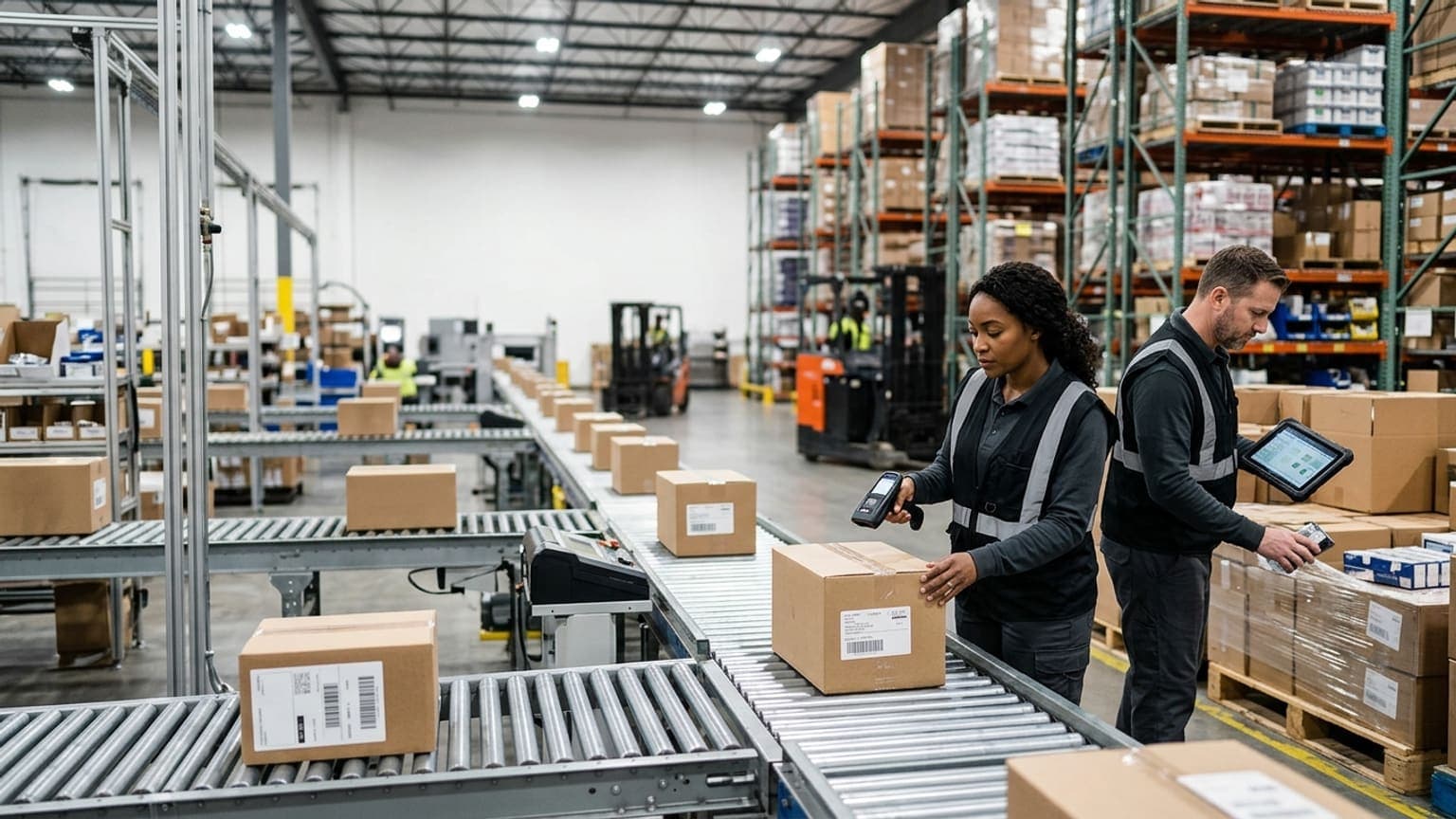
Warehouse Value-Added Services: How to Control Kitting, Labeling, and Custom Work Without Slowing Fulfillment

Warehouse value-added services can be profitable, sticky, and strategically important. They can also turn a clean fulfillment operation into a maze of side instructions, informal checks, late orders, and customer-specific rework.
The problem usually is not the service itself. Kitting, relabeling, inspection, returns refurbishment, personalization, store prep, inserts, and light assembly all make sense when the warehouse can control them. The problem starts when the work is treated as an exception instead of a designed workflow.
If every customer rule lives in a spreadsheet, every difficult order needs a supervisor, and every packer has a different memory of the process, value-added services become a hidden tax on throughput.
Here is how to design the workflow so custom work creates revenue without breaking fulfillment discipline.
Decide where the value-added service belongs
Not every value-added service should happen at the same point in the building.
The right location depends on when the item is stable enough to work on and when the order has enough context to make the service specific.
Common timing options include:
- Before picking: bulk relabeling, pre-kitting, quality inspection, retail compliance prep, and lot-level work that applies to many units.
- During picking: light validation, serial capture, lot confirmation, or customer-specific item selection.
- At consolidation: combining components from multiple zones, matching kits, checking order completeness, and routing orders that need special handling.
- At packing: inserts, branded packaging, gift notes, final label application, shipment photos, and carrier-specific documentation.
- In a separate work cell: personalization, refurbishment, repair, light assembly, repackaging, or any task that needs tools, fixtures, quality checks, or trained labor.
The wrong placement creates rework. If labeling happens before the final customer rule is known, the team may relabel the same unit twice. If kit assembly happens at packing, packers may become the bottleneck during cutoff. If inspection happens after consolidation, bad units may consume pick and handling labor before anyone stops them.
Start by mapping the service to the earliest point where the required information, materials, and item condition are all available.
Turn customer rules into triggers, not tribal knowledge
Warehouse value-added services fail when the trigger is vague.
Operators need to know exactly when a service is required. That trigger may come from:
- customer account
- sales channel
- SKU or product family
- order type
- lot, batch, expiration, or serial requirement
- destination country, retailer, or marketplace
- service level or ship method
- return disposition
- promotion, bundle, or kit definition
"This customer usually needs an insert" is not a workflow. "Orders for customer A, channel B, and SKU group C require insert version 3 before carton close" is a workflow.
The trigger should appear where the work happens. A picker does not need a pack-out instruction if the task belongs to packing. A packer should not discover a missing kit component after the carton is already built. A supervisor should not be the only person who knows which retailer requires a specific label position.
For warehouses already tightening downstream handoffs, warehouse order consolidation is a useful companion. Consolidation is often where custom work either becomes visible early or surprises the packing team too late.
Build verification into the value-added services workflow
Custom work needs verification because the cost of a small miss can be larger than the labor cost of the task.
A wrong label, missing insert, incomplete kit, incorrect serial number, or unapproved substitution can create chargebacks, returns, customer service tickets, and repack labor. The workflow should confirm the work while the operator still has the item in hand.
Useful verification points include:
- scan the item before the service starts
- scan the material, label, insert, component, or kit bill of materials
- confirm quantity and version
- capture lot, serial, or expiration data when required
- use a photo when appearance, condition, or placement matters
- require supervisor approval only for defined high-risk exceptions
- block release until the required steps are complete
Do not overbuild every task. A low-risk marketing insert may need a simple prompt. A regulated label, high-value kit, serialized component, or retailer compliance step may need stronger controls.
The practical question is: what proof would you need if the customer disputes the work later? Build that proof into the step, not into a manual investigation after shipment.
This is where photo capture can be valuable. The guide to warehouse photo evidence explains how to make images useful as records instead of loose files nobody can retrieve.
Protect packing from becoming the default custom-work station
Packing is often where value-added services end up by default. It is close to the customer order, close to the shipping label, and staffed by people who already handle final checks.
That does not mean packing should own every custom task.
Packing is a good fit for:
- final inserts
- branded dunnage or packaging
- ship-label and carton-label confirmation
- final photo evidence
- simple customer-specific documentation
- order-level quality checks
Packing is a poor fit for work that needs long setup time, specialized tools, material prep, rework space, curing time, refurbishment, detailed inspection, or multi-unit assembly. Those tasks slow the station and make the carrier cutoff harder to protect.
A useful rule is: packing should finish the order, not rescue the workflow.
If packers are constantly leaving the station to find labels, components, instructions, or approvals, the value-added service is not really designed. It is being absorbed by the last process before shipment.
For outbound teams mapping that pressure, warehouse packing station software covers the buyer requirements that help guided work, checks, and exceptions happen at the station without relying on memory.
Keep materials and instructions under inventory control
Many value-added services break because non-saleable materials are treated casually.
Labels, inserts, sleeves, polybags, retail tags, manuals, samples, kit components, warranty cards, and branded packaging all need control. If the warehouse cannot find the right material at the right time, the order stops. If the warehouse uses the wrong version, the order ships with a preventable defect.
For each service, define:
- where materials are stored
- who replenishes the work area
- how versions are retired
- how shortages are reported
- whether materials are lot-controlled or customer-owned
- how unused materials return to stock
- how substitutions are approved
The best workflow can still fail if the service cell runs out of the required insert during the final hour before cutoff. Treat service materials like operational inventory, not office supplies.
This is especially important for 3PLs. Customer-owned packaging and inserts may affect billing, inventory accountability, and service-level agreements. If those materials are invisible in the system, the warehouse will eventually absorb avoidable labor and customer escalation.
Separate exceptions from the clean flow
Value-added services create many small exceptions:
- missing or damaged materials
- unclear customer instructions
- item condition does not match the required service
- kit component short or substituted
- label version mismatch
- order arrives at the wrong station
- task completed physically but not posted in the system
- customer rule conflicts with carrier, retailer, or compliance requirements
If these exceptions stay in the main flow, operators either wait, improvise, or move the order forward with incomplete work.
Create a simple exception path with reason codes, ownership, and aging. Some issues belong to customer service. Some belong to inventory control. Some belong to quality. Some belong to a 3PL account manager. Some belong to systems support.
The important point is that clean orders keep moving while unclear orders move sideways into a controlled lane.
That same operating principle appears in warehouse exception management. Value-added services are a strong use case because the work often touches several teams but still has to ship on time.
Measure value-added services like a production process
If value-added services are billed, promised, or required for customer retention, they need real metrics.
Track:
- Labor minutes per service unit: actual work effort by service type and customer.
- First-pass yield: percentage of orders that complete the service without rework.
- Service dwell time: time from work release to completion.
- Material shortage rate: how often service work stops because supplies are missing.
- Defect rate: wrong label, missing insert, incomplete kit, wrong component, or poor workmanship.
- Exception aging: how long blocked orders wait for a decision.
- Cutoff impact: orders delayed or upgraded because value-added work finished late.
- Revenue versus labor cost: whether the service is priced correctly against actual handling.
Review these metrics by customer, channel, SKU family, service type, shift, and station. A profitable service on paper may be underpriced if it creates constant exceptions. A service that looks slow may be fine if the issue is material replenishment, not operator performance.
The goal is not to reject custom work. The goal is to know which services deserve better pricing, better system support, different placement, or a dedicated cell.
Where guided workflow tools help
Technology helps when it removes ambiguity at the point of work.
Useful capabilities include:
- service prompts triggered by order, SKU, customer, or channel
- scan validation for materials and components
- step-by-step task confirmation
- photo evidence tied to the order
- exception reason codes and owner routing
- WMS, OMS, shipping, and billing integration
- reporting by customer, service type, labor time, and defect cause
For teams that rely on customer-specific rules, a guided workflow like Warehouse Assistant can reduce dependence on tribal knowledge. The associate should see the next required step, the right material, the required proof, and the exception path without leaving the workstation.
The broader requirement is integration. Value-added service data should reach the systems that release work, reserve materials, confirm shipment, bill customers, and analyze margin.
Conclusion: custom work needs standard control
Warehouse value-added services work best when the custom task is supported by a standard operating model.
Define where the work belongs, what triggers it, which materials are required, how the operator verifies completion, where exceptions go, and which metrics show whether the service is profitable. Without that structure, custom work becomes supervisor memory and last-minute pack-out pressure.
Sizelabs helps warehouse teams capture the data, evidence, and guided workflows that make value-added services easier to control. If your operation is adding more customer-specific work, start by mapping the services that create the most rework today, then design the checks that keep clean orders moving.